
Key Takeaways
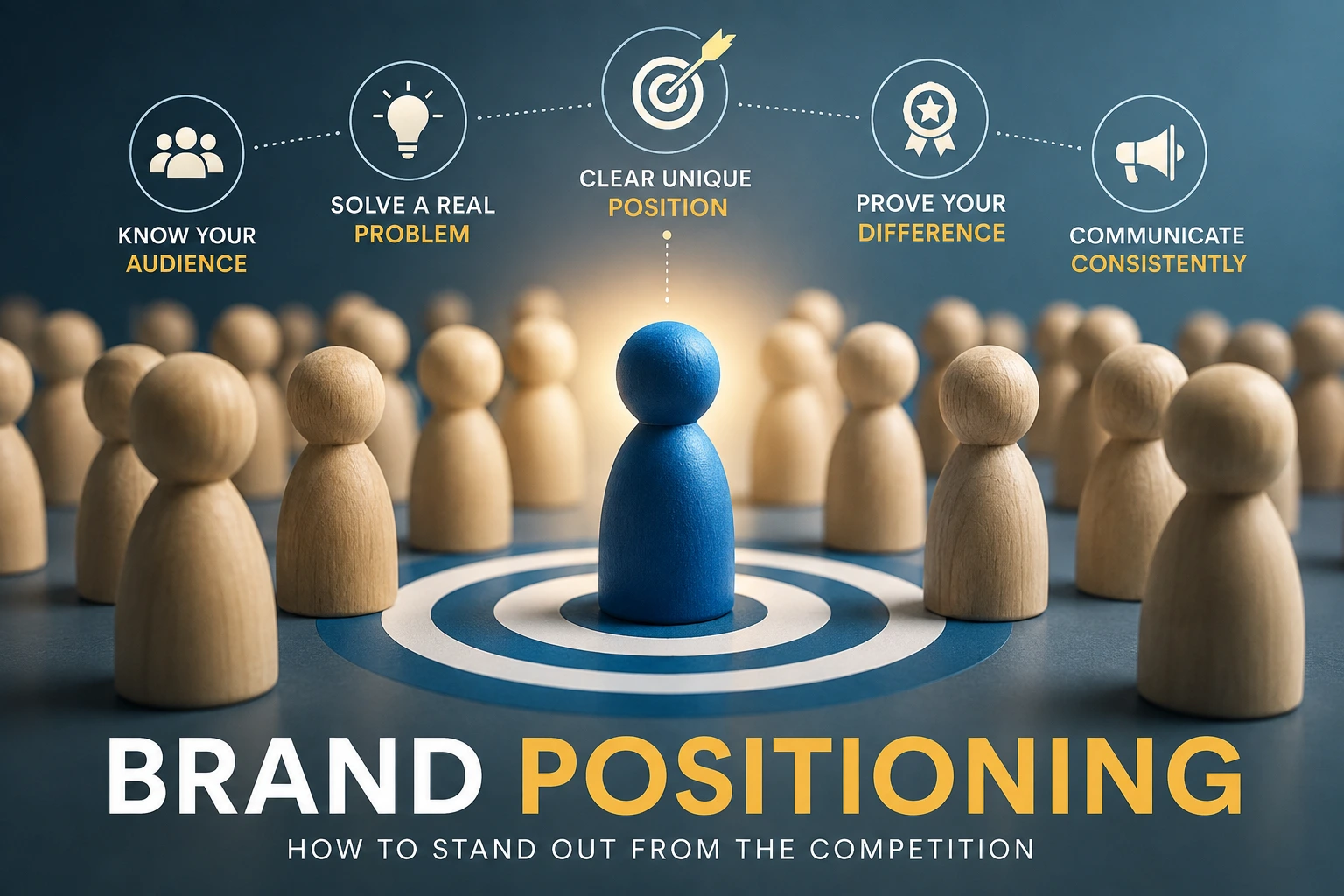
Brand positioning is the clear, credible reason a specific customer should choose you over alternatives. In saturated markets, standing out requires more than louder advertising. Choose a focused audience, solve a valuable problem, prove your difference, build recognisable brand assets, and repeat the same strategic promise across your product, pricing, content and customer experience. Australian businesses should also ensure marketing claims are accurate and supportable. Clear positioning can make a brand easier for customers, search engines and AI systems to understand.
Australian customers rarely struggle because they have too few choices.
The harder problem is choosing between businesses that appear almost identical.
Australia had 2,729,648 actively trading businesses at 30 June 2025. During 2024–25, 437,150 businesses entered the market while 370,500 exited. That does not mean every category is saturated, but it shows how constantly the competitive landscape changes.
When products, courses and professional services start looking interchangeable, spending more on promotion may simply make an unclear proposition louder.
Effective brand positioning solves a different problem.
It helps customers answer:
“Why should I choose this brand rather than the other reasonable alternatives?”
Seth Godin captures the wider idea neatly:
“A brand is the set of expectations, memories, stories and relationships…”
Positioning gives those expectations and memories a direction.
This guide explains how Australian businesses can build that direction deliberately.
What is brand positioning?
Brand positioning is the strategic place you want your brand to occupy in a customer’s mind relative to alternatives. It defines who the brand is for, the problem it solves, the value it provides and why customers should believe its promise. Strong positioning influences messaging, pricing, customer experience, product decisions and marketing.
Australian Government guidance defines positioning in practical terms as how you want customers to think about your product or service. It recommends clarifying what you do, who you do it for and why you differ from competitors.
That means positioning is not simply a tagline.
Consider these four ideas:
| Concept | Main question |
| Positioning | What space should we occupy in the customer’s mind? |
| Differentiation | What meaningful difference gives customers a reason to choose us? |
| Brand identity | Which visual and verbal cues make us recognisable? |
| Value proposition | What valuable outcome do customers receive? |
They should work together.
A beautiful identity cannot rescue an irrelevant position.
A strong differentiator is also wasted if customers cannot understand it.
Our take: Positioning is ultimately a choice. If five different audiences can interpret your proposition in five completely different ways, you probably have a list of capabilities rather than a position.
Why does brand positioning matter more in a saturated market?
A saturated market makes comparison easier. Customers see similar features, similar promises and similar advertising. Strong positioning reduces that ambiguity by associating the brand with a relevant problem, audience or advantage. The objective is not to appear different for its own sake. It is to become recognisable, relevant and credible when customers are ready to choose.
One of the most common responses to competition is adding more:
More features.
More messages.
More audiences.
More offers.
More claims.
That can make the position weaker.
David Ogilvy warned against businesses that:
“want it to be all things to all people.”
The principle remains useful decades later.
Trying to appeal equally to everyone usually produces language such as:
- high quality;
- innovative;
- trusted;
- customer focused;
- industry leading;
- comprehensive;
- tailored solutions; and
- excellent service.
Competitors can say the same things.
The issue is not that these qualities are undesirable. The issue is that they rarely establish a unique place in a buyer’s mind without evidence and context.
How do you stand out from the competition? Use this 9-step positioning strategy
To stand out in a saturated market, start with evidence rather than creative brainstorming. Choose the customers and buying situations that matter, map competitors, establish category expectations, identify a meaningful advantage, prove it, articulate a positioning statement, build distinctive assets, align customer experience and measure whether the intended perception is actually forming.
1. Choose who you need to matter to
Do not begin by asking:
“What makes us unique?”
Begin with:
“For whom do we need to be the best choice?”
A useful target is narrower than “Australian businesses”, “professionals” or “people interested in marketing”.
Look at:
- customer situation;
- problem;
- industry;
- buying trigger;
- existing alternative;
- decision criteria;
- level of expertise;
- budget;
- location where relevant; and
- outcome required.
A training provider, for example, could target:
“Marketing managers in Australian SMEs who need practical AI capability but cannot pause work for a full-time qualification.”
That description creates strategic constraints.
“Anyone interested in AI” does not.
Think about buying situations as well as personas
People do not permanently think about your category.
A useful question is:
What has happened immediately before they start looking?
Examples include:
- a promotion;
- a new compliance requirement;
- a failed campaign;
- a new employee;
- declining leads;
- a software implementation;
- expansion into a new market;
- a new competitor; or
- pressure to improve productivity.
These situations often produce stronger positioning than demographic descriptions alone.
2. Research the alternatives customers actually consider
Competitive positioning should analyse the alternatives buyers compare, not merely businesses that sell similar products. Those alternatives may include competitors, doing the work internally, free information, software, delaying the decision or doing nothing. Research the language, promises, pricing cues, proof and customer complaints surrounding each alternative.
The Australian Government recommends examining competitors’ target customers, positioning, communications, pricing, products and customer opinions.
Create a simple competitor matrix.
| Competitor | Audience | Main promise | Proof | Price position | Distinctive cues | Customer weakness |
| Competitor A | SME owners | Simplicity | Testimonials | Mid | Bold orange | Limited depth |
| Competitor B | Enterprise | Expertise | Credentials | Premium | Technical blue | Complex onboarding |
| Your brand | ? | ? | ? | ? | ? | ? |
Then examine customer language.
Useful sources include:
- interviews;
- sales calls;
- enquiry emails;
- reviews;
- search queries;
- support tickets;
- competitor reviews;
- Reddit discussions;
- LinkedIn comments;
- survey responses; and
- lost-deal interviews.
Do not merely ask customers what they “want from a brand”.
Ask what was happening when they started searching.
That usually reveals more useful positioning information.
3. Establish your points of parity before chasing uniqueness
A brand needs enough familiarity to be recognised as a legitimate category choice before differentiation becomes useful. Points of parity are the basic features, standards or expectations customers consider necessary. Meet those expectations first. Then decide which meaningful differences deserve disproportionate attention.
A café still needs acceptable coffee.
An accounting firm still needs accounting capability.
A digital-marketing course still needs coherent learning content.
Difference cannot compensate for failing the category’s fundamental expectations.
This matters because brands sometimes become so determined to appear unique that customers no longer understand what they sell.
A strong position normally contains both:
“I understand what category this belongs to.”
and:
“I understand why this particular option is worth considering.”
4. Find a difference that matters and can be proved
A useful differentiator must satisfy three tests: customers care about it, competitors cannot credibly claim it in exactly the same way, and your business can demonstrate that it is true. Difference without relevance becomes novelty. Difference without evidence becomes marketing language. Difference without operational delivery eventually damages trust.
Potential positioning territories include:
Audience specialisation
You understand a narrower customer unusually well.
Example:
“Cybersecurity training for Australian healthcare administrators.”
Outcome specialisation
You focus on a defined result.
Example:
“Analytics training designed to help marketing teams move from reports to campaign decisions.”
Process
Your method is distinct and explainable.
Delivery model
Live cohorts, workplace projects, mentoring or other delivery structures can become part of the position.
Customer experience
Ease, speed, access or support may matter more than product features.
Expertise
Specialist knowledge can be defensible where qualifications or experience can be demonstrated.
Business model
Subscription, fixed fees, modular learning or another commercial model can influence positioning.
Purpose
Purpose can matter when it genuinely shapes the business rather than existing as advertising copy.
Proven intellectual property
A genuine method, framework, dataset, technology or system can create a stronger moat.
Our take: “Different” is not automatically “better”. Ask whether the difference changes a buying decision. If it would not, it belongs lower in the messaging hierarchy.
5. Write a clear brand positioning statement
A positioning statement is an internal strategic tool that summarises the audience, category, valuable benefit, difference and supporting proof. It should guide decisions rather than become a public slogan. The statement is strong when teams can use it to decide what to say, what not to say and which opportunities fit the brand.
A practical formula is:
For [specific audience] who [need/problem], [brand] is the [category/frame of reference] that [most important outcome] because [credible reason to believe]. Unlike [main alternative], we [meaningful difference].
Illustrative example for a training business
For Australian SME marketing teams that need practical AI capability without leaving work, Example Academy provides applied professional training built around live workplace projects. Unlike passive video libraries, the programme focuses on guided application and feedback.
That is only an illustrative example.
A real organisation must replace every element with facts it can substantiate.
6. Turn positioning into distinctive brand assets
Positioning determines what a brand should mean. Distinctive assets help people recognise which brand is communicating that meaning. Consistent colours, shapes, typography, phrases, characters, sounds or other cues can improve recognition when they become strongly associated with one brand. They should be built and tested rather than changed whenever a campaign needs novelty.
Research from the Ehrenberg-Bass Institute distinguishes distinctive assets from generic design elements.
Strong assets become linked uniquely with the brand in memory. Examples might include a recognisable shape, colour system, phrase, character or sound.
The important distinction is this:
Differentiation answers why customers might choose you.
Distinctiveness helps them recognise and retrieve you.
A brand may need both.
If your website, course materials, ads and social posts appear to come from four different organisations, positioning becomes harder to encode in memory.
7. Align your offer, pricing and customer experience
Positioning becomes credible only when the customer experience supports it. A premium position needs premium evidence and delivery. A simplicity position requires simple processes. A specialist position requires specialist expertise. Product design, pricing, onboarding, support, content and sales behaviour should reinforce the same strategic idea.
This is where many positioning exercises fail.
The slide deck says:
“Easy.”
The form asks 27 questions.
The website says:
“Personal.”
Customers receive automated responses for a week.
The course says:
“Practical.”
Most lessons consist of passive slides.
Every contradiction teaches the customer something about your real brand.
If website experience is part of that mismatch, our guide to user experience and website traffic provides a useful companion framework.
8. Test the position before scaling promotion
Test positioning by exposing realistic customer segments to competing messages and observing comprehension, relevance, credibility and preference. Do not ask only whether people “like” the statement. Determine what they think the company offers, who they believe it serves, what they remember and whether the proposition changes their consideration.
A simple qualitative test can ask:
- What does this business appear to offer?
- Who is it designed for?
- What seems different?
- Which part matters most?
- Which claim is difficult to believe?
- What would you want proof of?
- Which alternative would you compare it with?
- How would you describe this company tomorrow?
Test more than wording.
You can test:
- landing-page propositions;
- ad concepts;
- pricing frames;
- visual assets;
- sales scripts;
- category descriptions;
- course names;
- call-to-action language; and
- proof formats.
Small positioning tests are cheaper than scaling a message that customers misunderstand.
9. Measure perception, not only clicks
Positioning measurement should combine perception research with behavioural and commercial indicators. Website traffic or impressions cannot tell you whether customers understand the intended position. Track what customers associate with the brand, whether the intended message is remembered, how qualified leads change and whether sales conversations increasingly reflect your strategic advantage.
Useful measures include:
| Metric | What it helps reveal |
| Unaided brand recall | Whether the brand comes to mind |
| Message association | Whether customers connect you with the intended benefit |
| Distinctive-asset recognition | Whether visual/verbal cues trigger the brand |
| Qualified enquiry rate | Whether the right audience responds |
| Win/loss reasons | Why customers choose alternatives |
| Branded search | Whether explicit demand for the brand changes |
| Price objections | Whether value perception is strengthening |
| Conversion rate | Whether clearer positioning assists action |
| Retention/repeat purchase | Whether delivery supports the promise |
| Customer language | Whether customers repeat your intended idea |
Do not interpret any single metric as proof of positioning success.
Combine perception and commercial data.
For a broader measurement framework, see our marketing analytics guide.
How should course and training providers position themselves?
Course providers should avoid competing only on topic, duration or price because competitors can often offer similar content. Stronger positioning connects a specific learner with a meaningful transformation and credible learning method. Audience expertise, practical application, instructor credibility, delivery format, support, assessment and workplace relevance can all contribute to a defensible position.
This is particularly important in categories such as:
- AI courses;
- digital marketing;
- data analytics;
- leadership;
- cybersecurity;
- project management; and
- professional development.
Generic course marketing often sounds like this:
“Learn practical skills from industry experts and advance your career.”
That could describe thousands of courses.
Compare these illustrative alternatives:
| Generic | More strategically positioned |
| Learn digital marketing | Digital marketing training for first-time SME marketing managers |
| Practical AI course | Workplace AI training built around approved business workflows |
| Flexible leadership course | Leadership training for newly promoted technical managers |
| Analytics course | Marketing analytics training focused on turning campaign data into decisions |
| SEO training | Search training for content teams responsible for organic growth |
The second column is not automatically superior.
Its advantage is specificity.
It gives the organisation a sharper hypothesis to test.
Be especially careful with outcome claims
Course providers should distinguish between:
- what the course teaches;
- what students practise;
- what support is provided; and
- what outcomes can genuinely be demonstrated.
Australian businesses should not make claims about benefits or future outcomes without reasonable grounds. The ACCC says marketing claims should be truthful, accurate and supportable.
Statements such as guaranteed employment, guaranteed income or guaranteed business results therefore require particularly strong substantiation.
What is a real-world example of clear positioning?
Canva demonstrates how a broad product can remain connected to a simple organising idea. Its stated mission is to “empower everyone in the world to design anything and publish anywhere”, while its public values include making complex things simple. That creates a recognisable strategic theme around accessibility and simplification rather than merely listing software features.
The lesson is not to copy Canva.
It is to notice the consistency.
Canva can add products, markets and features while still connecting them to the idea of making creation accessible.
For a smaller brand, the same strategic discipline matters even more.
You have less attention available.
Do not spend it communicating six unrelated propositions.
Should you compete on price in a saturated market?
Competing on price can be appropriate when low cost is deliberately built into the operating model and customers value it. It becomes dangerous when discounting is used to compensate for unclear positioning. Before reducing prices, determine whether customers understand the value, whether the right audience is being targeted and whether the offer is genuinely comparable.
Australian Government pricing guidance recommends comparing more than price. Businesses should also consider features, quality, service, demand and customers’ price sensitivity.
A business that cannot explain its difference often falls into a predictable loop:
Unclear value → customer compares price → discount → weaker margin → less investment → weaker experience → more price pressure.
Clear positioning can interrupt that loop.
It does not automatically justify premium pricing.
It simply gives customers more dimensions on which to evaluate the choice.
How much does brand positioning cost in Australia?
There is no standard Australian price for brand positioning. Cost depends on research depth, market complexity, number of audiences, stakeholder involvement, quantitative testing, messaging development and whether visual identity work is included. A founder-led workshop and a multi-market research project are fundamentally different engagements, so simple price comparisons can be misleading.
Instead of buying a vague “brand strategy”, ask what the engagement includes.
Useful deliverables may include:
- stakeholder interviews;
- customer research;
- competitive analysis;
- category analysis;
- segmentation;
- positioning territories;
- positioning statement;
- messaging architecture;
- evidence framework;
- brand-asset recommendations;
- testing; and
- implementation guidance.
The right question is not:
“How many strategy slides will I receive?”
It is:
“What decisions will we be able to make with greater confidence?”
What are the most common brand positioning mistakes?
The most common positioning mistakes are targeting everyone, mistaking features for meaningful benefits, copying competitors, making unsupported claims, changing brand assets too frequently, confusing visual identity with strategy and failing to test customer perception. Another major mistake is allowing sales, advertising, content and customer experience to communicate contradictory positions.
Mistake 1: Choosing a generic audience
“Businesses that want to grow” is rarely useful.
Mistake 2: Listing every advantage equally
A brand cannot own ten ideas in the customer’s mind with equal strength.
Prioritise.
Mistake 3: Copying category language
If every competitor is “innovative, trusted and tailored”, adding the same words creates camouflage.
Mistake 4: Inventing a difference
An unsupported claim creates legal and trust risks.
The ACCC expects businesses to substantiate claims.
Mistake 5: Rebranding too often
Recognition requires repeated exposure.
Ehrenberg-Bass research advises developing and protecting distinctive assets over the long term rather than treating them as disposable campaign decoration.
Mistake 6: Confusing positioning with a slogan
The positioning should govern the business.
A slogan merely expresses part of it.
Mistake 7: Ignoring intellectual property
A powerful name, phrase or distinctive asset may become commercially valuable.
IP Australia explains that registered trade marks can protect elements such as words, phrases, logos, colours and other brand identifiers.
Remember that registering a business name does not create the same exclusive rights as a trade mark.
When should you reposition a brand?
Reposition when evidence shows that the current position is no longer relevant, credible, competitively distinctive or aligned with the company’s offer. Repositioning may also be appropriate when entering a new market, changing the business model or serving a materially different customer. Do not reposition merely because the internal team is bored with existing branding.
Potential signals include:
- prospects consistently misunderstand the offer;
- your best customers differ from the intended audience;
- competitors have converged on your position;
- your business model has changed;
- a major customer need has changed;
- your claimed advantage no longer matters;
- sales teams cannot explain the company consistently; or
- research shows weak association with the intended benefit.
Keep what still carries recognition.
Change only what needs to change.
Can brand positioning improve SEO, AEO and GEO visibility?
Clear brand positioning can support search and answer-engine visibility because it produces clearer entities, topics, expertise signals, internal links and customer-focused content. However, there is no special positioning technique or schema that guarantees inclusion in Google AI Overviews, ChatGPT, Gemini, Perplexity or other generative systems. Useful, crawlable and well-supported content remains the foundation.
Google specifically states that no additional optimisation or special schema is required for AI Overviews or AI Mode. Pages must still be indexed, eligible for Search and supported by established SEO fundamentals.
That means positioning helps indirectly.
A focused business can build a coherent content ecosystem around:
Audience → problem → expertise → methodology → evidence → service → entity.
A vague brand creates vague content.
A clear position gives editorial teams boundaries.
Instead of publishing everything related to “marketing”, a specialist brand might repeatedly demonstrate expertise in:
“measurement systems for Australian SME marketing teams.”
That creates greater thematic coherence.
Our content strategy and brand storytelling guide explores the relationship between clear brand narratives, SEO, AEO and generative discovery in more depth.
What should businesses publish to make their positioning believable?
Publish evidence that demonstrates the position rather than repeating promotional claims. Useful proof includes original research, transparent methodology, subject-matter explanations, demonstrations, customer questions, case studies where permission and evidence exist, comparison frameworks, documented processes and expert commentary. Each piece should reinforce a recognisable area of expertise.
For example:
Do not publish 20 articles saying:
“We are experts in digital marketing.”
Publish work that allows readers to reach that conclusion independently.
That could include:
- original benchmarks;
- practical tutorials;
- process breakdowns;
- annotated examples;
- tools;
- templates;
- expert interviews;
- research methods;
- decision frameworks; and
- lessons from real implementation.
This approach also aligns with Google’s recommendation to create helpful, reliable and people-first content rather than content manufactured primarily to manipulate rankings.
A practical 30-day brand positioning plan
You can develop an initial evidence-based position in four weeks by separating research, strategic choices, implementation and testing. Thirty days is enough to produce and validate a useful hypothesis, although complex businesses may need longer research. The objective is not perfect wording. It is a defensible decision that can be tested in the market.
Week 1: Understand the market
Interview customers.
Review sales conversations.
Analyse competitors.
Study reviews and search behaviour.
Identify buying triggers and recurring frustrations.
Week 2: Make strategic choices
Choose the priority audience.
Define category expectations.
Identify the most valuable difference.
Collect evidence.
Draft three possible positioning territories.
Reject ideas that cannot be defended.
Week 3: Translate strategy into execution
Write the positioning statement.
Create messaging pillars.
Prioritise proof.
Audit visual and verbal brand assets.
Update critical website sections.
Align sales language.
Week 4: Test
Run customer interviews.
Test landing-page messages.
Collect sales-team feedback.
Record misunderstandings.
Measure qualified enquiry behaviour.
Refine the position.
Then repeat.
Brand positioning is not a sentence you write once.
It is a strategic hypothesis that becomes stronger through evidence, consistency and market feedback.
The final test: can customers explain why you are different?
A strong brand positioning strategy ultimately makes choice easier.
You do not need every person in Australia to believe your brand is best.
You need the right people to understand:
This is for me.
It solves a problem I care about.
I understand why it is different.
I believe the evidence.
I can recognise the brand again.
That is a much stronger foundation than trying to be louder than every competitor.
If you are working through how your services should be positioned and communicated online, Pulse Reach Digital can help turn a clear position into search visibility, landing pages and enquiries. A free website and lead generation audit is a good place to start.
The aim should not be to manufacture uniqueness.
It should be to make your most valuable, credible difference easier to understand and easier to remember.
FAQ Section
1. What is brand positioning?
Brand positioning is the place a business aims to occupy in customers’ minds relative to competing alternatives. It defines the target audience, relevant problem, principal value, competitive difference and evidence supporting the brand’s promise.
2. What is a brand positioning strategy?
A brand positioning strategy is the plan used to establish and reinforce a desired market perception. It normally combines customer research, competitor analysis, market segmentation, value proposition development, differentiation, messaging, distinctive brand assets and measurement.
3. How do you stand out in a saturated market?
Focus on a specific customer and valuable problem. Research competing alternatives, identify a meaningful difference, prove that difference and communicate it consistently across your product, pricing, content, brand identity and customer experience.
4. What is the difference between branding and positioning?
Positioning determines what you want the brand to mean relative to competitors. Branding is broader and includes the identities, experiences, communications and associations through which customers recognise and experience the brand.
5. What is the difference between positioning and differentiation?
Differentiation describes the meaningful qualities that separate an offer from competitors. Positioning determines how those differences should influence customer perception. Differentiation gives customers a reason to choose; positioning establishes the strategic context for that choice.
6. What makes a good positioning statement?
A strong positioning statement identifies the target customer, relevant need, category, principal benefit, competitive difference and evidence supporting the claim. It should be specific enough to guide business decisions and exclude opportunities that do not fit.
7. Can a company stand out without lowering prices?
Yes. Businesses can differentiate through specialisation, expertise, process, convenience, customer experience, product quality, service model, intellectual property or other meaningful benefits. However, these differences need to matter to customers and be supported by evidence.
8. How should a course provider position its courses?
Start with a specific learner and desired outcome rather than the subject alone. Differentiate through audience expertise, delivery method, instructor credibility, practical application, support, assessment, workplace relevance or another evidence-based advantage.
9. How often should a brand reposition?
There is no fixed schedule. Reposition when customer research, competitive changes, a new business model or poor market comprehension shows that the existing position has become irrelevant, unbelievable or strategically unsuitable.
10. How can you measure brand positioning?
Measure both perception and behaviour. Useful indicators include message association, unaided recall, distinctive-asset recognition, qualified enquiries, branded search, conversion, price objections and customer explanations of why they chose the business.
Is your positioning clear on your website?
We check how your site, Google profile and ads explain what makes you different, and where enquiries leak.




0 Comments