
Key takeaway
Email marketing is not dead. A permission-based subscriber list gives your business a direct, portable way to communicate with people who have chosen to hear from you.
Unlike a social following, your list is not entirely dependent on one platform’s feed. Unlike paid advertising, it does not disappear the moment you pause your budget.
But an email database only becomes an asset when it is built with consent, protected carefully and used to deliver genuine value.
Australian businesses are dealing with more expensive attention, crowded social feeds and customers who expect relevant communication. A disciplined email marketing strategy helps turn anonymous website visitors into known prospects, first-time customers into repeat buyers and useful content into an ongoing relationship.
This guide explains how to build that system without relying on spam, empty newsletters or inflated claims.
Email Marketing Funnel
A successful email marketing funnel moves visitors from discovering your business to becoming loyal customers through permission-based communication and valuable content.
What is email marketing?
Email marketing is the use of permission-based email communication to educate prospects, promote relevant products or services, support customers and strengthen relationships. It includes one-off campaigns, recurring newsletters and automated messages triggered by a subscriber’s behaviour or stage in the customer journey.
A basic email might announce a new service. A more mature program could send different content based on what a person downloaded, purchased, viewed or requested.
Common email marketing activities include:
- Educational newsletters.
- Product or service announcements.
- Welcome sequences.
- Lead-nurture campaigns.
- Event invitations.
- Quote or enquiry follow-ups.
- Abandoned-cart reminders.
- Post-purchase education.
- Renewal reminders.
- Re-engagement campaigns.
Email marketing is not the same as sending unsolicited sales messages to a list of scraped addresses. Sustainable email programs are built around permission, relevance and clear expectations.
Is email marketing dead?
No. Email remains a standard digital communication channel and continues to support acquisition, nurturing, customer service and retention. What is losing effectiveness is low-quality email: generic broadcasts, misleading subject lines, purchased lists, excessive frequency and messages that provide no clear value.
People have predicted email’s decline for decades. Yet organisations continue to use it for account access, receipts, service information, newsletters, product education and business communication.
That does not mean every email marketing campaign succeeds. Inbox competition is intense, spam controls are stronger and customers can quickly leave a list that wastes their time.
The useful question is therefore not, “Is email dead?”
It is:
Has your business earned a place in the subscriber’s inbox?
A successful program usually earns that place by being:
- Expected.
- Recognisable.
- Relevant.
- Easy to read.
- Worth opening.
- Honest about its purpose.
- Easy to leave.
Why is an email list considered an owned asset?
An email list is often called an owned asset because the business controls the subscriber records, content, sending schedule and customer relationship rather than depending entirely on a third-party content feed. However, this control is conditional: subscribers retain privacy rights and may withdraw consent at any time.
“Owned” should not be interpreted as unrestricted ownership of people or their personal information.
A more accurate description is a business-controlled, permission-dependent marketing asset.
You can generally export subscriber data from a reputable email platform, move it into another compatible system and continue communicating with people who have validly consented. That portability makes email materially different from followers who exist only inside a social platform.
Owned, rented and earned audiences
| Audience type | Example | Main advantage | Main limitation |
| Owned or business-controlled | Permission-based email list, CRM contacts, website audience | Greater control, portability and direct communication | Requires consent, security, maintenance and ongoing value |
| Rented | Paid search, social advertising, sponsored placements | Rapid reach and targeting | Exposure usually stops when spending stops |
| Platform-dependent | Social followers or marketplace customers | Easy discovery and community interaction | Reach, account access and rules are controlled by the platform |
| Earned | Media coverage, recommendations, organic mentions | Third-party credibility | Timing, wording and distribution are not fully controlled |
The best marketing strategies combine all four.
Search and social media can introduce people to your business. Paid campaigns can accelerate discovery. Useful content can earn attention. Email can then continue the relationship with people who actively choose to subscribe.
What makes an email database genuinely valuable?
A valuable email database is not simply a large collection of addresses. Its value comes from consent quality, subscriber relevance, engagement, accurate records, useful segmentation, documented acquisition sources and the business’s ability to turn communication into measurable customer outcomes.
A list of 2,000 relevant subscribers who recognise your business may be more useful than 50,000 contacts who never requested your emails.
Six qualities of a strong email asset
1. Proven consent
You should be able to show how and when a person subscribed. Records might include:
- Form source.
- Date and time.
- consent wording displayed at sign-up.
- IP or system record where appropriate.
- Double opt-in confirmation.
- Customer relationship supporting inferred consent.
The ACMA states that senders are responsible for proving consent and recommends keeping records of who consented, when they consented and how. (acma.gov.au)
2. Clear audience relevance
Subscribers should have a genuine connection to your market. A national newsletter about commercial property will not become valuable simply because unrelated consumer addresses were added to it.
3. Healthy engagement
Engagement can include clicks, replies, downloads, enquiries, bookings, purchases and preference updates. Open rate can still provide directional information, but it should not be treated as a perfect measure.
Apple’s Mail Privacy Protection can privately download remote content and prevent senders from reliably determining whether an email was opened. This makes clicks, conversions and downstream behaviour increasingly important. (Apple Support)
4. Useful segmentation
A strong database records more than an address. With appropriate consent and privacy controls, useful fields might include:
- Customer or prospect status.
- Product interest.
- Service location.
- Industry.
- Purchase history.
- Content interests.
- Lead source.
- Engagement stage.
- Communication preferences.
Collect only what you can justify and protect. More data is not automatically better.
5. Portability and documentation
Your team should know how to export contacts, automations, templates, suppression lists and consent records. The business should not depend on one employee’s memory or an undocumented platform setup.
6. A repeatable content system
A list loses value if nobody knows what to send. Document your campaign types, audience segments, approval process, sending rhythm, reporting method and brand voice.
How do you build an email marketing asset from scratch?
Start by defining a useful reason to subscribe, creating transparent opt-in points and sending a welcome message that confirms what people will receive. Then connect subscriber data to your CRM, establish a consistent publishing rhythm and improve the system using clicks, conversions, replies and customer feedback.
Step 1: Define the list’s purpose
Avoid starting with “We need a newsletter.”
Start with a customer problem.
Ask:
- What does the audience need help understanding?
- What information would save them time or money?
- What questions arise before they buy?
- What would help existing customers get more value?
- What updates are genuinely worth receiving?
A local accounting firm might offer monthly tax and cash-flow guidance. A home-services business might send seasonal maintenance reminders. A B2B consultancy might publish practical insights for decision-makers.
These examples are illustrative rather than claimed case studies.
Step 2: Create a compelling reason to subscribe
“Join our newsletter” is usually too vague. Explain the exchange.
A useful subscription promise could be:
- One practical industry lesson each fortnight.
- Monthly regulatory updates in plain English.
- Early access to workshops or events.
- A checklist, calculator or template.
- Product-care advice for customers.
- Local market alerts.
- A short series answering common buying questions.
Pulse Reach Digital’s content marketing services can support the guides, articles and lead resources that give people a legitimate reason to join a list.
Step 3: Use transparent opt-in forms
Tell subscribers:
- Who will email them.
- What they will receive.
- How often emails are likely to arrive.
- Whether offers will be included.
- Where they can read the privacy policy.
- How they can unsubscribe.
Avoid pre-ticked boxes and ambiguous language such as “Continue” when the action also subscribes someone to marketing.
Step 4: Record the source of every contact
Your system should distinguish contacts who came from:
- A newsletter form.
- A downloadable resource.
- Checkout.
- An event.
- A consultation request.
- An existing customer relationship.
- A manual import.
- A partner campaign.
Source records make segmentation, performance analysis and compliance reviews easier.
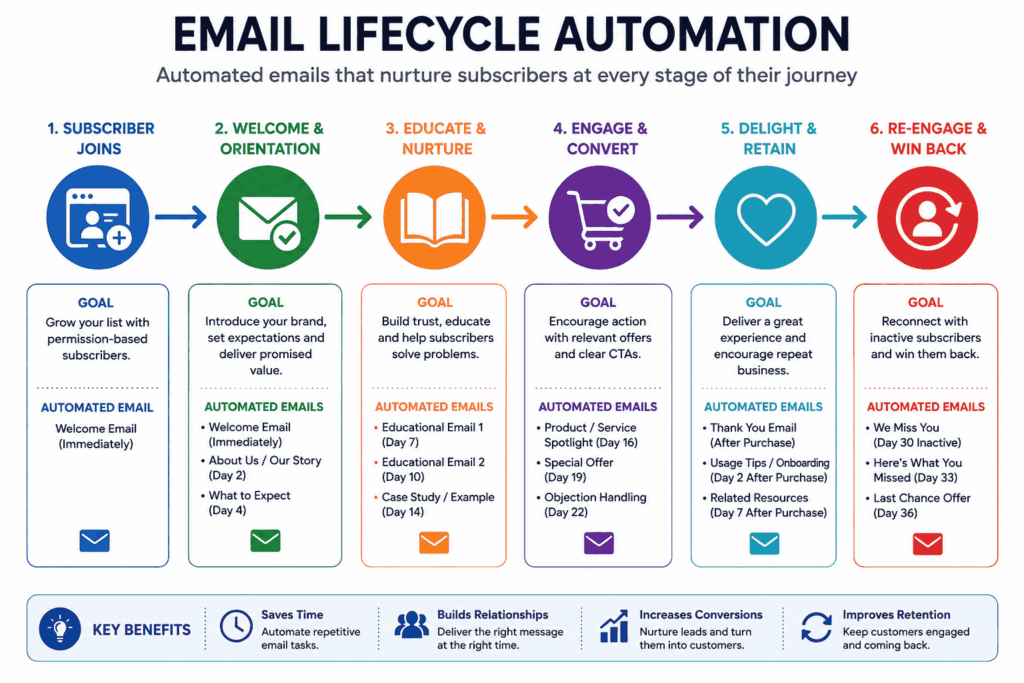
Step 5: Send a welcome sequence
A welcome email confirms the relationship while interest is fresh.
A simple three-email sequence could be:
- Welcome and expectation setting: Deliver the promised resource and explain what comes next.
- Best educational content: Answer a common question or help the subscriber solve a small problem.
- Relevant next step: Invite the reader to explore a service, reply with a question or update their preferences.
Do not turn every welcome email into an immediate sales pitch. Trust is usually more valuable than short-term pressure.
CRM Workflow
A Customer Relationship Management (CRM) workflow helps businesses organise leads, automate follow-ups, improve customer communication, and build long-term relationships from the first enquiry through ongoing customer retention.
Lead Capture
Collect enquiries from website forms, landing pages, live chat, phone calls, referrals, and social media.
Lead Qualification
Automatically score and categorise leads based on their interests, location, service needs, or buying intent.
Follow-up Automation
Send welcome emails, reminders, SMS messages, and assign follow-up tasks to the sales team.
Sales Opportunity
Track proposals, consultations, quotes, meetings, and customer interactions inside the CRM.
Customer Retention
Continue engagement through newsletters, support emails, renewals, feedback requests, and loyalty campaigns.
Step 6: Establish a useful sending rhythm
There is no universal perfect frequency.
A weekly email can work when the content is consistently valuable. A monthly email may be more suitable for a business with fewer meaningful updates. Automated messages can operate alongside either schedule.
Choose a frequency your team can maintain without padding emails with filler.
Step 7: Build a preference centre
Where practical, let subscribers choose:
- Topics.
- Product categories.
- Email frequency.
- Event notifications.
- Promotional messages.
- Educational content.
A preference centre can preserve a relevant relationship when the alternative would be a complete unsubscribe. It must not make unsubscribing difficult.
Step 8: Maintain the database
Review:
- Hard bounces.
- Repeated soft bounces.
- Spam complaints.
- Long-term inactivity.
- Duplicate records.
- Broken personalisation fields.
- Invalid or role-based addresses.
- Contacts without reliable consent records.
List cleaning is not about forcing engagement. It is about protecting sender reputation and respecting people who no longer want the content.
What are the best email marketing campaigns to send?
The best email marketing campaigns match a clear audience need and a specific lifecycle moment. Most businesses should begin with a welcome series, an educational newsletter, lead nurturing and post-purchase support before investing in complex predictive automation.
| Campaign | Trigger or timing | Main purpose | Useful call to action |
| Welcome series | Immediately after subscription | Set expectations and build trust | Read, reply or choose preferences |
| Educational newsletter | Weekly, fortnightly or monthly | Maintain awareness and demonstrate expertise | Read a guide or explore a topic |
| Lead-nurture sequence | After a guide download or enquiry | Answer questions and reduce uncertainty | View a service or book a discussion |
| Product or service announcement | Meaningful launch or change | Inform relevant subscribers | Learn more |
| Event campaign | Before a webinar, workshop or event | Drive registrations and attendance | Register |
| Abandoned-cart sequence | Incomplete ecommerce purchase | Help customers return to checkout | Complete purchase |
| Post-purchase sequence | After purchase | Improve onboarding and satisfaction | Use, review or reorder |
| Renewal reminder | Before expiry | Prevent avoidable churn | Renew |
| Re-engagement campaign | Sustained inactivity | Confirm interest or preferences | Stay subscribed or update choices |
| Customer feedback email | After a suitable experience | Learn and improve | Complete a short survey |
Example Monthly Email Campaign Calendar
A balanced email marketing calendar combines educational content, customer engagement, promotional campaigns, and retention activities. The goal is to deliver consistent value instead of sending only sales-focused emails.
| Week | Campaign | Objective | Audience | Primary Call-to-Action |
|---|---|---|---|---|
| Week 1 | Educational Newsletter | Share a helpful guide, industry tips or expert insights. | All Subscribers | Read the Article |
| Week 2 | Customer Engagement | Invite readers to download a checklist, attend a webinar or watch a video. | Active Subscribers | Download Resource |
| Week 3 | Promotional Campaign | Introduce a service, product update or limited-time offer. | Qualified Leads | Book a Consultation |
| Week 4 | Customer Success | Provide onboarding tips, product education or maintenance advice. | Existing Customers | Learn More |
| End of Month | Feedback Survey | Collect reviews, testimonials and customer feedback. | Recent Customers | Complete Survey |
| Quarterly | Re-engagement Campaign | Reconnect with inactive subscribers or update communication preferences. | Inactive Contacts | Stay Subscribed |
A successful campaign calendar balances educational, promotional and customer support emails. Many businesses follow an approximate 80/20 approach, where around 80% of emails focus on providing useful information and relationship building, while 20% promote products or services. The exact mix should reflect your audience, industry and business goals.
Campaigns versus automations
A campaign is commonly a scheduled message sent to a selected audience.
An automation is triggered by a condition, event or time interval.
Examples of triggers include:
- A form submission.
- A first purchase.
- A page or product interaction, where tracking is appropriately disclosed.
- A booking date.
- An expiring subscription.
- A period of inactivity.
- A change in customer status.
Automation saves repetitive work, but it also creates risk when nobody reviews outdated messages. Audit automations regularly for broken links, old prices, incorrect claims and irrelevant timing.
How do you create email campaigns people want to read?
Effective emails make one clear promise, deliver useful information quickly and give the reader an obvious next step. Strong campaigns are designed around relevance rather than decoration. They use recognisable sender details, accurate subject lines, mobile-friendly formatting and content that respects the subscriber’s time.
Write a recognisable sender name
Use a consistent sender identity such as:
- Pulse Reach Digital.
- First name at Pulse Reach Digital.
- A clearly named team or publication.
Do not disguise a bulk message as a personal reply.
Google’s sender guidance says display names should clearly identify the sender and should not imitate urgency, a threaded reply or a verified identity. (Google Support)
Write an accurate subject line
A good subject line creates a reason to open without misrepresenting the message.
Instead of:
Urgent: You need to read this now
Try:
Five email fixes for a healthier subscriber list
Avoid false “Re:” or “Fwd:” labels, misleading scarcity and promises the email cannot support.
Use the preview text
Preview text should extend the subject rather than repeat it.
Subject: Is your email list becoming a liability?
Preview: Check consent records, inactive contacts and sender authentication.
Put the value near the top
Do not make readers scroll through a long company introduction before discovering why the message matters.
A useful structure is:
- Main point.
- Short explanation.
- Supporting example.
- Clear action.
Design for mobile reading
Use:
- Short paragraphs.
- Descriptive headings.
- Large, readable text.
- Tappable buttons.
- Adequate spacing.
- Compressed images.
- Descriptive alt text.
- A plain-text version where supported.
Give each email a primary goal
One email can contain several links, but it should normally have one main purpose.
Examples:
- Read the guide.
- Register for the event.
- Compare the options.
- Book an assessment.
- Complete the purchase.
- Update preferences.
Personalise with purpose
Useful personalisation changes the relevance of the message. It is not limited to inserting a first name.
Examples include:
- Showing content related to a selected interest.
- Sending onboarding information for the purchased service.
- Adapting advice to a customer’s lifecycle stage.
- Excluding existing customers from acquisition offers.
- Sending location-relevant information.
Poorly maintained personalisation can be worse than none. “Hello FNAME” immediately damages trust.
How should email marketing performance be measured?
Measure email marketing against business outcomes, not a single engagement metric. Track list growth quality, deliverability, clicks, enquiries, purchases, assisted conversions, unsubscribes and complaints. Use open rates as directional information rather than definitive proof of attention.
Core measurement framework
| Measurement area | Metrics | Question answered |
| List health | Valid subscribers, consent coverage, growth source, bounce rate | Are we building a relevant and usable audience? |
| Deliverability | Delivery rate, rejected messages, spam complaints, authentication status | Are messages reaching inbox providers successfully? |
| Engagement | Unique clicks, replies, preference updates, content visits | Are subscribers taking meaningful action? |
| Conversion | Enquiries, bookings, purchases, renewals, downloads | Is email contributing to the intended outcome? |
| Retention | Repeat purchases, renewal rate, churn, reactivation | Does email strengthen customer relationships? |
| Efficiency | Revenue or leads per send, cost per outcome, production time | Is the program commercially sustainable? |
Use campaign-specific goals
A newsletter may aim to generate qualified website visits.
A renewal reminder should be judged on renewals.
An onboarding sequence may be judged on product adoption, support demand or completion.
A re-engagement email may be successful even when it reduces list size, because uninterested contacts leave and the remaining audience becomes more relevant.
Improve attribution carefully
Use:
- Consistent UTM parameters.
- CRM campaign fields.
- Ecommerce tracking.
- Call-tracking where appropriate.
- Form-source data.
- Unique landing pages.
- Sales notes.
- Customer surveys asking how people found the business.
Attribution will rarely be perfect. A customer might read several emails, search for the brand later and then call. Evaluate email as part of the journey rather than demanding that every interaction receive one exclusive credit.
What are the Australian email marketing rules?
Australian commercial emails generally require recipient consent, accurate sender identification and a functional unsubscribe mechanism. Businesses remain responsible when an agency or platform sends messages on their behalf. Consent records and reliable suppression processes should therefore be treated as core parts of the marketing system.
The ACMA’s spam guidance states that marketing senders must first have consent. Messages must identify the sender, include correct contact details and make unsubscribing easy. Unsubscribe requests must be honoured within five working days, and the unsubscribe option must remain functional for at least 30 days after the message is sent. (acma.gov.au)
The Australian Government’s email and text message marketing guidance provides a practical summary for businesses. (business.gov.au)
Express consent
Express consent occurs when someone knowingly agrees to receive marketing.
Examples can include:
- Selecting an unticked subscription box.
- Completing a clearly labelled newsletter form.
- Agreeing during a recorded phone or in-person interaction.
- Opting into relevant offers at checkout.
Inferred consent
Inferred consent can apply in narrower circumstances when a person has directly provided their address and would reasonably expect relevant marketing because of an ongoing relationship.
It should not be treated as a blanket permission to email every past purchaser indefinitely. The ACMA notes that express consent is more reliable and that inferred consent depends on the context and relationship. (acma.gov.au)
Purchased and scraped lists
A vendor’s claim that a list is “opted in” does not automatically establish consent for your business.
The sender remains responsible for the addresses used. Address-harvesting software and lists created through it are also prohibited under Australian spam rules. (acma.gov.au)
Privacy considerations
Commercial email messages are primarily governed by the Spam Act, but privacy obligations can still affect how personal information is collected, stored, combined and used.
The OAIC’s direct marketing guidance explains that organisations covered by the Australian Privacy Principles may have additional obligations concerning personal information and direct marketing. (OAIC)
Enforcement is not theoretical
In March 2026, the ACMA reported that Lululemon Athletica Australia paid a $702,900 penalty after sending more than 370,000 emails containing commercial content without an unsubscribe facility. (acma.gov.au)
In July 2026, the ACMA reported a $2.7 million penalty involving TAB after marketing communications were sent to customers who had unsubscribed from specific channels, alongside telemarketing breaches. (acma.gov.au)
These examples show why businesses should test unsubscribe processes across promotional, transactional and mixed-content templates.
Important: This section provides general information, not legal advice. Obtain advice for your circumstances, especially in health, finance, gambling, education or other regulated sectors.
How do SPF, DKIM and DMARC affect email marketing?
SPF, DKIM and DMARC help receiving systems verify that messages are authorised and have not been improperly altered or impersonated. Correct authentication does not guarantee inbox placement, but missing or misaligned authentication can lead to rejection, spam placement and damage to domain reputation.
SPF
Sender Policy Framework identifies which systems are authorised to send email for a domain.
DKIM
DomainKeys Identified Mail adds a cryptographic signature that receiving systems can validate.
DMARC
Domain-based Message Authentication, Reporting and Conformance builds on SPF and DKIM. It helps domain owners define how unauthenticated messages should be handled and provides reporting.
Current Gmail requirements
Google requires all senders to personal Gmail accounts to use SPF or DKIM, valid DNS records and TLS, among other requirements.
Senders delivering more than 5,000 messages per day to personal Gmail accounts must meet additional requirements, including SPF, DKIM, DMARC alignment and one-click unsubscribe for marketing or subscribed messages. Google also instructs senders to keep reported spam rates below 0.3%, while recommending a rate below 0.1%. (Google Support)
Yahoo also recommends authentication, low complaint rates, easy unsubscribing and separation of promotional and transactional traffic in its sender best-practice guidance. (Senders)
Practical deliverability checklist
- Send from a domain your business controls.
- Configure SPF, DKIM and DMARC.
- Use a recognisable From name.
- Keep promotional and transactional content appropriately separated.
- Avoid sudden volume increases.
- Remove hard bounces.
- Honour unsubscribes promptly.
- Monitor spam complaints.
- Avoid URL shorteners in important campaigns.
- Test links and rendering.
- Never buy addresses.
- Do not repeatedly email long-term inactive contacts without a clear strategy.
How does email marketing work with SEO, social media and paid advertising?
Email works best as part of an integrated system. Search, social media and advertising attract attention; your website converts some of that attention into permission-based subscribers; email then nurtures the relationship and returns qualified people to useful content, services or offers.
Email and SEO
SEO helps people discover useful pages. Email helps those people continue learning after the first visit.
A practical workflow is:
- Publish a helpful search-focused guide.
- Offer a related checklist or update series.
- Invite readers to subscribe transparently.
- Send relevant follow-up content.
- Use subscriber questions to improve future articles.
Pulse Reach Digital’s SEO services focus on search intent, technical performance, content strategy and qualified visibility.
Email and social media
Social content can attract new audiences and demonstrate brand personality. Email provides a path for interested followers to maintain a direct relationship.
Do not abandon social media. Use it to grow awareness, then give followers a clear reason to join your email community.
Explore Pulse Reach Digital’s social media marketing services for integrated planning, content and performance tracking.
Email and paid media
Paid campaigns can generate leads, but the economics improve when you do more than collect a single enquiry.
With appropriate permission, an email nurture sequence can:
- Answer common objections.
- Share relevant proof.
- Explain the buying process.
- Bring undecided prospects back.
- Prepare leads for a more productive sales conversation.
Pulse Reach Digital’s guide to aligning digital marketing with sales explains why campaigns should make sales conversations easier rather than merely increasing lead volume. (pulsereachdigital.co)
What are the biggest email marketing mistakes?
The most damaging mistakes are sending without reliable consent, buying contacts, treating every subscriber identically, measuring success only through opens and allowing automations to run without review. These practices weaken trust, reduce deliverability and can create legal or reputational risk.
Avoid:
- Hiding marketing consent inside unrelated terms.
- Importing old spreadsheets without checking their source.
- Sending every message to the full database.
- Using fake urgency.
- Making unsubscribing difficult.
- Continuing to email people who opted out.
- Mixing promotional content into service emails without appropriate controls.
- Ignoring mobile design.
- Using oversized images instead of accessible text.
- Sending from an unauthenticated domain.
- Automating messages without ownership or review dates.
- Reporting opens without reporting conversions.
- Keeping data indefinitely without a defined purpose.
- Copying AI-generated content into campaigns without factual and brand review.
What is a practical 90-day email marketing plan?
A 90-day plan should prioritise foundations before volume. The first month establishes consent, technology and audience value. The second launches essential lifecycle messages. The third introduces segmentation, testing and outcome-based reporting.
Days 1–30: Build the foundation
- Audit all existing contact sources.
- Remove clearly invalid or unsupported records.
- Confirm your platform and CRM responsibilities.
- Configure SPF, DKIM and DMARC.
- Review privacy and consent wording.
- Create one clear subscription promise.
- Improve the main sign-up form.
- Define core metrics and UTM conventions.
- Assign an internal owner.
Days 31–60: Launch the essentials
- Build a welcome sequence.
- Create a reusable newsletter template.
- Publish the first educational campaign.
- Add a lead-nurture sequence for one priority service.
- Test mobile rendering and links.
- Document the approval process.
- Confirm that unsubscribes update all relevant systems.
Days 61–90: Improve relevance
- Segment prospects, customers and inactive contacts.
- Test one meaningful variable at a time.
- Create a re-engagement or preference campaign.
- Connect campaign data to enquiries or sales.
- Review deliverability and complaints.
- Interview customer-facing staff for recurring questions.
- Plan the next quarter around customer needs rather than promotional dates alone.
Should an Australian business invest in email marketing?
Email marketing is worth considering when your business has repeat purchases, a considered buying process, useful expertise, recurring services or a need to nurture prospects over time. It is less valuable when the business has no permission-based audience, no useful content and no capacity to maintain the program responsibly.
Email is not a replacement for a strong offer, website, service or sales process.
It is an infrastructure layer that helps good marketing continue working after the first click.
The asset is not the software. It is the combination of:
- Permission.
- Trust.
- Useful customer information.
- Reliable technology.
- Consistent content.
- Organisational knowledge.
- Measurable customer relationships.
That combination cannot be built through one promotional blast. It grows each time the business sends something relevant, respects a preference and learns from a genuine customer action.
Build the relationship, not just the list
Email marketing is not dead, but careless email marketing deserves to disappear.
The opportunity for Australian businesses is to create a smaller, healthier and more useful audience that has actively chosen the relationship.
Start with consent. Set a clear promise. Build one welcome sequence. Measure actions that matter. Then improve the system gradually.
Pulse Reach Digital helps Australian businesses connect content, search, paid campaigns, customer journeys and conversion strategy. To explore where email could fit within your broader growth system, contact Pulse Reach Digital for a practical discussion.
FAQs
Yes. Email remains useful for educating prospects, supporting customers, promoting relevant offers and encouraging repeat business. Results depend on consent quality, audience relevance, deliverability, content and measurement rather than the channel alone.
An owned audience is a group of people a business can communicate with through systems it controls, such as a permission-based email database. The term does not remove subscribers’ privacy rights or their ability to unsubscribe.
Neither is universally better. Social platforms are useful for discovery and community interaction. Email provides more direct and portable communication. Strong strategies use social media to attract attention and email to continue relationships.
Sometimes, but a previous purchase does not automatically create unlimited marketing permission. Express consent is safer. Inferred consent depends on the relationship, expectations and relevance of the message. Obtain legal advice when uncertain.
Buying a list creates serious consent, deliverability and reputation risks. The sender remains responsible for proving that recipients consented to receive marketing from that specific business.
It should accurately identify the sender, provide valid contact details and contain a clear, functional unsubscribe option. The sender must also have consent before sending the commercial message.
Send as often as you can provide expected, relevant value. Some audiences welcome weekly education, while others prefer monthly updates. Set expectations during sign-up and monitor unsubscribes, complaints and conversions.
A welcome sequence is usually the best starting point. It can deliver the promised resource, explain what subscribers will receive and direct them to the most relevant next step.
Email segmentation divides subscribers into relevant groups based on factors such as customer status, interests, purchase history, location or behaviour. It helps businesses avoid sending the same message to everyone.
Welcome emails and promotions can produce immediate actions, but a valuable email asset develops over months or years. List quality, content consistency, buying cycles and the strength of the offer all affect timing.
Costs depend on subscriber volume, platform, sending frequency, CRM integration, content production, design, automation complexity and professional management. Businesses should compare total operating cost with qualified leads, sales, retention and staff time saved.


0 Comments