

Key Takeaways
Semantic SEO is the practice of structuring content around entities, topics, and user intent — not isolated keywords — so search engines and AI answer engines can understand meaning, not just match strings. It grew out of Google’s Knowledge Graph and Hummingbird update, and it now underpins how Google, Bing AI, ChatGPT Search, Gemini, and Perplexity decide which pages to cite. Below is the short version; the full guide follows.
- Semantic SEO means writing for topics and entities, not exact-match keywords.
- It began with Google’s 2012 Knowledge Graph and 2013 Hummingbird update, and expanded through RankBrain, BERT and MUM.
- Topical authority — comprehensive, interlinked coverage of a subject — is the practical output of a semantic SEO strategy.
- A semantic content core groups pillar pages and supporting content around one topic, connected by internal links and shared entities.
- AEO (answer engine optimisation) for AI Overviews, ChatGPT Search, and Perplexity relies on the same semantic signals as traditional Google ranking.
- Schema.org structured data helps confirm entity relationships that semantic search algorithms already infer from content.
- Success is measured by topic-level visibility (share of voice across a keyword cluster), not single-keyword rank tracking.
If you have written page after page around individual keywords and watched rankings stall anyway, semantic SEO is very likely the gap. Google stopped matching search queries to exact strings more than a decade ago; it now matches them to concepts, entities, and the relationships between them. That shift means a single well-structured page about a topic can outrank ten thin pages built one-keyword-at-a-time. This guide breaks down what semantic SEO actually means, how the underlying search framework changed, and — most usefully — how to implement it: building a semantic content core, strengthening entity relevance, and measuring results at the topic level rather than the keyword level.
What Is Semantic SEO?
Semantic SEO is the practice of optimising content around meaning, context, and entity relationships rather than isolated keywords, so search engines can match a page to the full range of ways a topic is searched. It draws on natural language processing and Google’s Knowledge Graph to connect a page to related concepts, questions, and entities, which is why one well-built page can rank for hundreds of semantically related queries instead of one.
The term sits alongside — and is often confused with — entity SEO and topical authority. They overlap heavily: entity SEO focuses on the people, places, brands and concepts a page is “about”; topical authority is the outcome of covering a subject comprehensively; semantic SEO is the overarching discipline that makes both possible.
Semantic SEO Meaning: From Keywords to Concepts
Semantic SEO meaning, in practice, is a shift from “which keyword am I targeting” to “which topic and set of related concepts am I the best answer for.” Traditional SEO treated each keyword as a near-independent target, often producing separate thin pages for close variants of the same query. Semantic SEO groups those variants — and the underlying questions behind them — into one comprehensive resource, because search engines already understand that “semantic seo meaning”, “what is semantic seo” and “semantics seo” are the same underlying intent.
This is also where the industry shorthand “semantics SEO” comes from — practitioners describing the same discipline from slightly different angles (linguistics-first versus search-engineering-first), but referring to one strategy.
Why Semantic Search Changed the Fundamentals of SEO
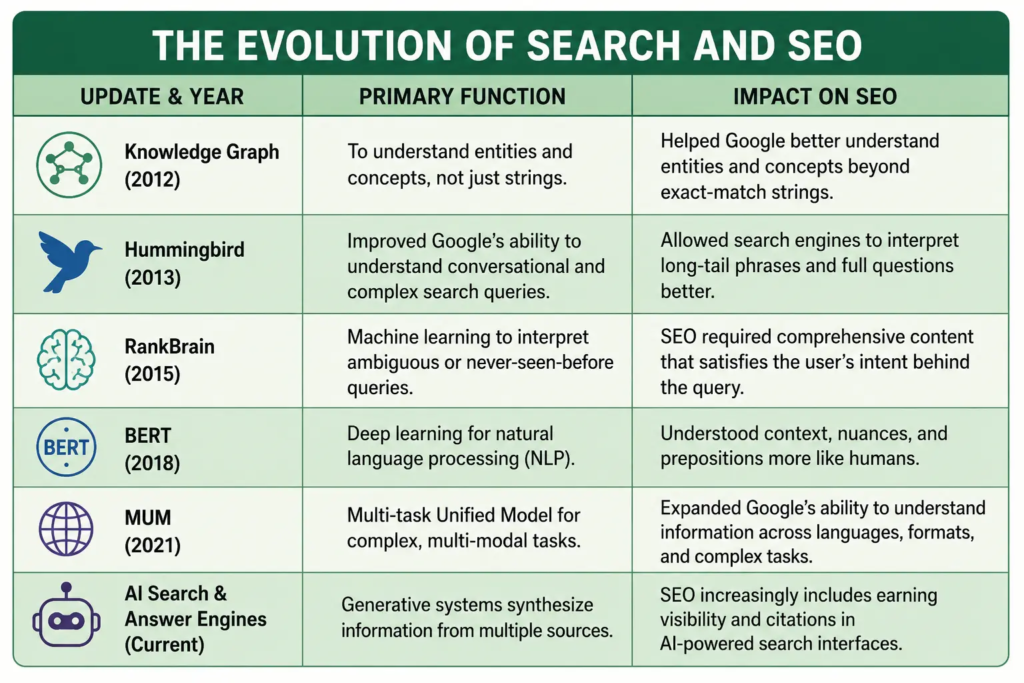
Google’s shift to a semantic search framework began with the 2012 Knowledge Graph and the 2013 Hummingbird update, and it changed SEO fundamentals by replacing exact-match keyword matching with intent and entity matching. Each subsequent model — RankBrain (2015), BERT (2018) and MUM (2021) — extended the system’s ability to parse natural language, ambiguous phrasing, and multi-step questions.
The Knowledge Graph itself launched as a database connecting people, places and things, described by Google search executive Amit Singhal at the time as an attempt to search “more like how humans understand the world” — a design goal that still shapes how modern ranking systems and AI Overviews interpret a page’s topic (source: TechRadar, reporting on Google’s Knowledge Graph launch).
| Update / System | Year | What Changed |
|---|---|---|
| Knowledge Graph | 2012 | Introduced entity-based search results (people, places, things) alongside links |
| Hummingbird | 2013 | Rebuilt the core algorithm to interpret full queries and intent, not just keywords |
| RankBrain | 2015 | Added machine learning to interpret ambiguous or never-seen-before queries |
| BERT | 2018 | Improved understanding of context and word relationships within a sentence |
| MUM | 2021 | Enabled multi-step, multi-format understanding across languages and media |
| AI Overviews / SGE | 2023–2026 | Uses the same entity and topic signals to generate synthesised, cited answers |
The practical implication: content built around a single exact-match phrase is now competing against content built around the full topic. The topic-first approach almost always wins, because it is what the underlying models are designed to reward.
Semantic SEO and Topical Authority
Topical authority is what a website earns when its semantic SEO is executed well: comprehensive, well-linked coverage of a subject that signals depth of expertise to both search engines and readers. It is built, not claimed — through a cluster of interlinked pages that each answer one facet of a topic, all pointing back to a central pillar page.
Three markers indicate topical authority is developing:
- The site ranks for a growing share of the keyword cluster around a topic, not just one head term.
- Internal links flow logically between pillar and supporting content, reflecting real relationships between subtopics.
- AI answer engines (AI Overviews, ChatGPT Search, Perplexity, Gemini) begin citing the site as a source for related questions.
Keywords vs Topics: A Semantic SEO Strategy Overview
A keyword-first strategy targets one search phrase per page; a topic-first semantic SEO strategy targets one subject per content cluster, deliberately covering every related question and entity. The table below summarises the practical differences.
| Dimension | Keyword-First SEO | Topic-First (Semantic) SEO |
|---|---|---|
| Unit of planning | Individual search phrase | Topic cluster / subject area |
| Content output | Many thin, overlapping pages | One comprehensive pillar + supporting pages |
| Ranking signal relied on | Exact or close keyword match | Entities, context, intent, and relationships |
| Risk after Core Updates | High — thin pages often lose rankings together | Lower — depth and structure are harder to devalue |
| AI Overview / AEO fit | Weak — narrow answers are easily out-cited | Strong — comprehensive pages are natural citation sources |
Building a Semantic Content Core (Semantic Core SEO)
A semantic core is the master map of entities, topics, and related questions a website intends to own, from which every pillar and supporting page is planned. Building one is the practical starting point for semantic content SEO, and it typically follows four steps.
- Define the core topic and list every entity genuinely related to it (people, tools, methods, industry bodies, locations for local intent).
- Cluster the secondary keywords and questions under that topic by sub-intent (definitional, comparative, how-to, cost, local).
- Map one pillar page per core topic and one supporting page per sub-intent cluster, avoiding duplicate targeting.
- Interlink pillar and supporting pages using descriptive, entity-rich anchor text rather than generic “click here” links.
Semantic Relevance, Relationship and Connectivity in SEO
Semantic relevance measures how closely a page’s content matches the meaning behind a query; semantic relationship and connectivity describe how clearly a page’s entities and internal links connect to related topics across the wider site. All three are strengthened by the same set of on-page practices:
- Naming entities explicitly rather than relying on pronouns (“Pulse Reach Digital’s SEO services” rather than repeated “we” or “our services”).
- Answering related questions within the same page instead of scattering them across unrelated posts.
- Using structured data (Schema.org) to make entity relationships machine-readable, not just human-readable.
- Linking to genuinely related internal pages, so crawlers can trace the topic map a human reader would infer.
Structured data does not create relevance on its own — it confirms relationships already present in well-written content, a distinction Schema.org’s own documentation makes clear when describing how markup should reflect existing page content rather than substitute for it.
Implementing Semantic SEO for Better Rankings
Implementing semantic SEO for better rankings means auditing existing content against a topic map, consolidating overlapping pages, and rewriting for entities and intent rather than keyword density. A practical rollout for an existing Australian business site looks like this:
- Audit current pages against the target topic list; flag thin, overlapping, or keyword-duplicate pages for consolidation.
- Rebuild the strongest page per topic into a pillar, folding in unique value from the pages it replaces (301 redirect the rest).
- Add a concise, direct-answer summary (40–60 words) under every H2 that answers a discrete question — this is what AI Overviews and featured snippets tend to lift.
- Expand entity coverage: name related tools, methods, locations, and industry terms naturally within the copy.
- Add Schema.org markup (Article, FAQPage, LocalBusiness where relevant) that mirrors what’s already on the page.
- Build internal links from related existing content into the new pillar, and from the pillar out to supporting pages.
- Re-check search intent quarterly — Google’s understanding of a topic’s semantics shifts as language and Search Generative behaviour evolve.
Programmatic Semantic SEO at Scale
Programmatic semantic SEO applies the same entity-and-topic logic across large numbers of pages — typically location, product, or category variants — using a shared template built around real entity data rather than duplicated text. It works well for multi-location service businesses (a common Australian SME case: one core service, many suburbs) but only when each page carries a genuinely distinct entity — local landmarks, service-area specifics, real testimonials — rather than the same paragraph with a suburb name swapped in.
Done poorly, programmatic pages read as doorway pages and risk action under Google’s spam policies, which explicitly address scaled content abuse — a useful check before scaling any template-based rollout.
Measuring Success With Semantic SEO
Success in semantic SEO is measured at the topic level — share of voice across a full keyword cluster, growth in unique ranking queries per page, and AI Overview or answer-engine citations — rather than the rank of one keyword. The table below outlines the shift in reporting.
| Legacy Metric | Semantic SEO Equivalent |
|---|---|
| Rank for one keyword | Number of unique queries a single page ranks for |
| Page-level traffic | Topic cluster traffic (pillar + supporting pages combined) |
| Backlinks per page | Internal + external links reinforcing the topic’s entity graph |
| Featured snippet count | Featured snippet + AI Overview + AI answer-engine citation count |
Common Mistakes to Avoid
- Treating entities as keywords to stuff, rather than concepts to explain naturally.
- Publishing a pillar page without building or linking the supporting cluster around it.
- Adding Schema.org markup for facts that aren’t actually stated in the visible content.
- Running programmatic pages with near-duplicate text and no genuine local or product-level detail.
- Ignoring existing overlapping pages instead of consolidating them into one authoritative resource.
Frequently Asked Questions
What is semantic SEO?
Semantic SEO is optimising content around topics, entities, and search intent rather than individual keywords, so search engines understand what a page means, not just what words it contains.
What does semantic SEO mean in simple terms?
It means writing for the full subject a reader is trying to understand, covering related questions and concepts in one place instead of splitting them across many thin pages.
Why is semantic SEO important?
It aligns content with how modern search algorithms and AI answer engines actually evaluate relevance — through entities and context — making rankings more stable and easier to earn across a whole topic.
How is semantic SEO different from traditional keyword SEO?
Traditional SEO targets one keyword per page; semantic SEO targets one topic per content cluster, covering every closely related keyword, question and entity within it.
What is topical authority in semantic SEO?
Topical authority is the credibility a site builds by comprehensively covering a subject through an interlinked pillar-and-cluster content structure, signalling depth of expertise to search engines.
How do I start building a semantic content core?
List the entities and sub-questions related to your core topic, cluster them by intent, then map one pillar page and several supporting pages before writing any content.
Does structured data (schema markup) improve semantic SEO?
Yes — Schema.org markup helps confirm entity relationships already present in your content, though it cannot substitute for genuinely relevant, well-structured writing.
What is programmatic semantic SEO?
It’s applying a shared, entity-driven template across many similar pages (for example, one service across many suburbs), which only works well when each page includes genuinely unique, page-specific detail.
How do I measure semantic SEO success?
Track topic-level metrics: how many unique queries a page ranks for, cluster-wide traffic, and citations in AI Overviews or AI answer engines, rather than a single keyword’s rank.
Can semantic SEO help with Google AI Overviews and AI Overviews-style answers?
Yes — AI Overviews, ChatGPT Search, Gemini and Perplexity all rely on entity and context signals similar to core search ranking, so semantic SEO improves visibility across both.
Putting topical authority into practice happens page by page. Our on-page SEO services cover the structure, headings and internal links this relies on.




0 Comments