
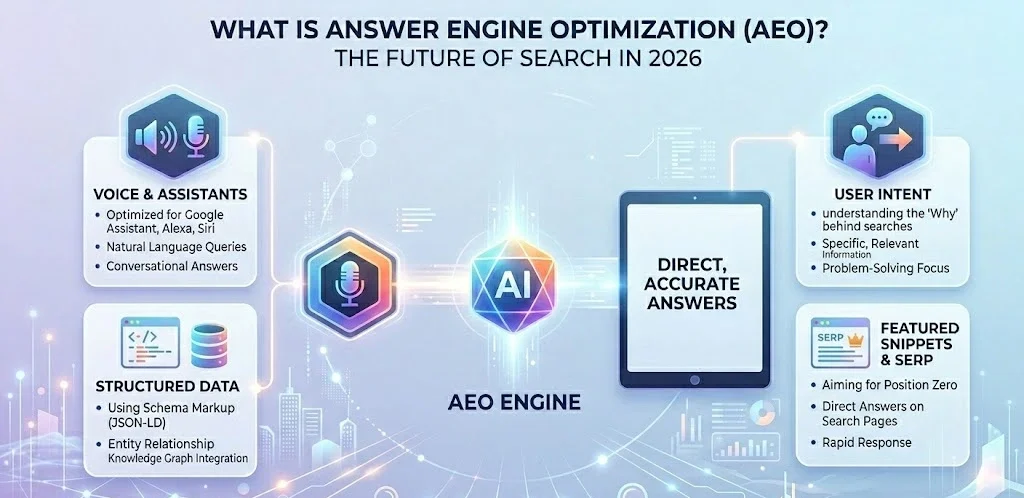
Key Takeaways:
Before we dig in, here is what you need to know right now.
AEO (Answer Engine Optimization) is the practice of structuring content so AI-powered platforms — Google AI Overviews, ChatGPT, Perplexity, and Microsoft Copilot — select it as a cited answer to user questions.
GEO (Generative Engine Optimization) is a closely related discipline focused on getting your brand woven into the narratives that large language models (LLMs) construct when they generate responses. Many practitioners use both terms interchangeably, and the tactics overlap heavily.
The numbers that matter in 2026:
- AI-referred sessions to websites grew 527% year-over-year through mid-2025 (Frase, 2026)
- Google AI Overviews now appear on over 30% of Australian search queries (Uprise Digital, 2026)
- Zero-click searches represent 65–70% of all Google queries (SparkToro, 2026)
- AI-citation traffic converts at 3–4 times the rate of regular organic search (Cubitrek, 2026)
- The Princeton GEO study found that adding expert quotes boosts AI visibility by roughly 41%, statistics by 30%, and citations by 30%
If your content cannot be easily extracted, trusted, and cited by an AI engine, you are invisible to a fast-growing share of your potential customers — before they ever visit your website.
Who Should Read This Guide?
This post is for you if:
- ✅ You run or market a small-to-medium business in Sydney or anywhere in Australia
- ✅ You are an SEO professional, content strategist, or digital marketer adapting to AI search
- ✅ You have noticed your Google traffic softening but cannot explain why
- ✅ You are building a new content strategy and want it to work in both Google and ChatGPT
- ✅ You want to understand the real difference between AEO, GEO, and traditional SEO
If none of those fit, this guide is still worth a skim. The shift in how Australians search affects every business with a website.
What is Answer Engine Optimization (AEO)?
Answer Engine Optimization (AEO) is the process of creating and structuring content so that AI-powered search platforms can understand it, extract from it, and deliver it as a direct answer to a user’s question. Unlike traditional SEO — which aims to get you a link on page one — AEO aims to make your content the answer.
Think about the last time you typed a question into your phone and got a spoken response, or opened ChatGPT to ask something you used to Google. That answer came from somewhere. AEO is how you make sure it comes from you.
The term sits alongside Generative Engine Optimization (GEO), which focuses more specifically on how large language models synthesise and cite your content. In practice, the strategies overlap so heavily that most agencies treat them as one unified program. For clarity, this guide uses AEO as the umbrella term unless the distinction matters.
How Has Search Actually Changed in Australia?
The shift is real and measurable. Australians are not just typing keywords anymore.
According to a 2026 Australian search behaviour report, people now ask their phones things like: “Find me a licensed electrician in Surry Hills who can fix a switchboard today and has five-star reviews.” That is a full sentence with intent, location, and criteria — not a keyword. AI agents are built to handle exactly this kind of query, and they return one or two business names, not ten blue links.
Here is how the landscape has shifted:
| Old Search Behaviour | 2026 Search Behaviour |
| Type keywords, browse links | Ask a full question, get one answer |
| Click through to websites | Get the answer in-platform (zero click) |
| Google holds 90%+ of market | Google at 89.34%, AI platforms growing fast |
| SEO = get on page one | AEO = become the answer itself |
| CTR drives visibility | Citation frequency drives visibility |
The practical consequence for Sydney businesses: if you are not showing up in AI-generated answers, a growing portion of your potential customers are forming opinions about your competitors — before they ever see your website.
What is the Difference Between SEO and AEO?
SEO and AEO are not competitors. They are partners. SEO gets your content discovered and indexed. AEO adds the structure and credibility signals that AI systems need to actually use it.
Here is the clearest way to separate them:
- Traditional SEO answers the question: “How do I rank higher in Google’s organic results?”
- AEO answers the question: “How do I become the source an AI cites when it answers my customer’s question?”
Both require quality content, strong site architecture, and authoritative backlinks. Where they diverge:
| Factor | Traditional SEO | AEO |
| Goal | Higher ranking | Become the cited answer |
| Content format | Long-form, keyword-rich | Answer-first, structured, extractable |
| Success metric | Rankings and CTR | Citation frequency and AI visibility |
| Structured data | Helpful | Essential |
| Voice search | Secondary | Primary consideration |
| Key platforms | Google SERPs | ChatGPT, Perplexity, Google AI Overviews, Copilot |
The mistake most Sydney businesses make is treating AEO as a replacement for SEO. It is not. A strong SEO foundation — fast site, quality backlinks, crawlability — is still what gets you into the pool of sources an AI considers. AEO is what gets you cited from that pool.
How Do AI Search Engines Actually Find and Use Answers?
Understanding the process helps you optimise for it. When a user asks an AI engine a question, roughly five things happen:
1. Query interpretation. The engine uses natural language processing (NLP) to understand intent, not just keywords. “Best digital marketing agency Sydney” and “Which Sydney agency is good at Google Ads?” are recognised as related intents.
2. Source selection. The AI pulls from indexed web content, trusted domains, knowledge graphs, and previously cited pages. Fresh, authoritative, well-structured content ranks higher in this selection phase.
3. Answer synthesis. The AI does not copy text. It extracts key facts, statistics, and explanations, then rewrites them in natural language. This is why your exact phrasing matters less than your factual clarity.
4. Citation. The engine attributes specific claims back to source documents. Content with clear, citable facts — specific numbers, named entities, verifiable claims — is far more likely to be cited than content full of vague generalisations.
5. Response delivery. The user gets a synthesised answer, often without needing to click through. The cited sources may appear as links, but many users never visit them.
The key insight: AI systems reward content that removes friction between a question and a trustworthy answer. Walls of text, buried conclusions, and keyword-stuffed paragraphs all fail this test.
Why Does AEO Matter for Sydney Businesses Right Now?
Here is something most Sydney agencies are not telling their clients clearly enough: AI search is already here, and it is reshaping local discovery.
Right now, Australians are typing queries like “Who is the best accountant in Parramatta?” and “Find a web designer in the CBD with experience in Shopify” into ChatGPT, Google Gemini, and Perplexity. These platforms return one or two business names. The businesses that show up have — often without realising it — content that AI engines can parse, trust, and cite.
The businesses that do not show up are invisible for those queries, regardless of where they rank in traditional Google results.
The local AEO opportunity is wide open. Most Sydney SMEs have not adjusted their content strategy for AI search. The businesses that move now will build a citation footprint that compounds over time, much like domain authority did in the early days of SEO.
Specific advantages for Sydney businesses acting now:
- Local entity signals (suburb names, landmark proximity, local licences) increase citation probability for geo-specific queries
- Conversational queries about local services are growing faster than generic informational queries
- AI platforms actively favour businesses with consistent, verified entity information across Google Business Profile, ABN lookup, and their own website
What is GEO (Generative Engine Optimization) and How is it Different?
GEO (Generative Engine Optimization) is the practice of making your brand, expertise, and content easy for large language models to understand, trust, and weave into their generated responses. Where AEO focuses on structured snippets and direct answers, GEO is about influencing the broader narrative an AI builds around a topic.
The line between them is blurry, and that is fine. The Princeton GEO study — one of the most cited pieces of academic research on this topic — found that adding expert quotes, statistics, and inline citations to content significantly increases the likelihood of being cited in AI-generated responses.
GEO vs AEO: a practical distinction:
- AEO = “Make my content easy to extract as a direct answer” (think featured snippets, voice search, AI Overviews)
- GEO = “Make my brand part of the story AI tells about my industry” (think ChatGPT recommending your agency unprompted when asked about digital marketing in Sydney)
Both matter. Both use similar tactics. The easiest way to think about it: AEO wins the snippet; GEO wins the recommendation.
What Role Does Schema Markup Play in AEO?
Schema markup is the language that makes your content machine-readable. Without it, AI systems have to guess what your content is about. With it, you are telling them directly.
Schema is added to your website as structured data — usually in JSON-LD format — and it labels your content in ways search engines and AI platforms understand immediately.
The most important schema types for AEO in 2026:
- FAQPage — marks up question-and-answer content for direct extraction
- HowTo — signals step-by-step instructional content
- LocalBusiness — proves your physical location and service area to AI engines
- Service — defines exactly what you offer
- Article — signals content type and authorship
- Organization — strengthens brand entity recognition across AI platforms
One thing most guides miss: schema alone is not enough. If your structured data says one thing and your visible page content says another, you create a trust problem rather than a clarity signal. Schema and content must align.
For Sydney businesses, implementing LocalBusiness schema with your suburb, postcode, and service radius is one of the highest-impact, lowest-effort AEO wins available right now. You can validate your implementation using Google’s Rich Results Test and the Schema Markup Validator.
How Can Sydney Businesses Optimise for AI Search in 2026?
Here is the practical implementation framework. These are not theoretical suggestions — they are the tactics that are showing measurable results in 2026 for Australian businesses.
1. Lead with your answer
Every page and every major section should open with a clean 40–60 word answer to the primary question it addresses. AI systems scan for these “answer blocks” first. If your answer is buried in paragraph five, the AI may never surface it.
2. Use question-based headings
Format your H2s and H3s as the actual questions your customers type into ChatGPT or Google. “How much does SEO cost in Sydney?” performs better for AEO than “Our SEO Pricing.” This matches what practitioners call “Query Fan-Out Coverage” — making sure your content covers the sub-questions that AI breaks a complex prompt into.
3. Write in subject-verb-object sentences
AI agents extract facts more reliably from clear, direct sentences. “Pulse Reach Digital manages Google Ads campaigns for Sydney SMEs” is more citation-ready than “We offer a comprehensive range of paid search solutions.”
4. Add verifiable data points
Specific statistics, dates, and names increase citation probability. Vague claims like “most businesses see results” give an AI nothing to cite. “Businesses implementing AEO see AI-citation traffic convert at 3–4x the rate of regular search” is citable.
5. Implement FAQPage schema
Add JSON-LD FAQPage schema to any page with a Q&A section. This is one of the clearest AEO signals you can send, and it is supported by Google, Bing, and used by most AI platforms to identify extractable content.
6. Keep content fresh
Research from AirOps found that for commercial queries, 83% of AI citations came from pages updated within the past 12 months, and over 60% from pages refreshed within six months. Add a “Last updated” date and refresh your key pages regularly.
7. Build entity consistency
Your business name, address, phone number, and service descriptions should be identical across your website, Google Business Profile, and any third-party directories. AI systems use entity consistency as a trust signal. Inconsistencies reduce your citation probability.
What Are Featured Snippets and How Do They Connect to AEO?
A featured snippet is the direct answer box that appears at the top of a Google search result — often called “position zero.” AEO is the discipline that earns these placements, and it is also what helps you get cited in AI Overviews and voice search.
Featured snippets are essentially an early form of what AI Overviews do today. Google identifies a page that answers a query clearly and concisely, then surfaces that answer directly on the results page. The same signals that earn a featured snippet — structured content, direct answers, schema markup — are the same signals that get you cited in ChatGPT and Perplexity.
Types of featured snippets most relevant to AEO:
| Snippet Type | Best Content Format | AEO Opportunity |
| Paragraph snippet | 40–60 word definition or answer | Definition queries, “What is” questions |
| List snippet | Numbered or bulleted list | How-to, steps, ranked options |
| Table snippet | Comparison table | Price comparisons, feature comparisons |
| FAQ snippet | FAQPage schema + Q&A content | “People Also Ask” queries |
For a Sydney digital marketing agency, capturing featured snippets for local service queries (“What does an SEO agency do?”, “How much does Google Ads management cost in Sydney?”) is both a traditional SEO win and a strong AEO signal.
What Are Google AI Overviews and Why Should You Care?
Google AI Overviews are the AI-generated summary boxes that now appear at the top of many Google search results, synthesising information from multiple sources before showing any organic links.
They launched as Search Generative Experience (SGE) in 2023 and have rapidly expanded. By late 2025, AI Overviews were appearing on over 30% of Australian search queries. That number continues to climb.
Here is why this changes everything for content strategy:
- When an AI Overview appears, it absorbs most of the click intent. Users get their answer without scrolling.
- The sources cited inside the AI Overview receive a small “source” label — brand exposure without necessarily a click
- Pages that are cited tend to be the same pages that rank in traditional organic results, but with additional AEO signals — structured data, clear answers, strong entity clarity
The practical implication: You cannot ignore AI Overviews. They are now part of Google, not a separate product. Optimising for AEO is, in many ways, optimising for Google itself.
Google’s May 2026 AI search guidance confirmed that AEO is still fundamentally SEO — it builds on the same foundations of quality, expertise, and trustworthiness. The structure just needs to be tighter and the answers need to be more immediately extractable.
Is AEO Replacing SEO? The Honest Answer
No. AEO is not replacing SEO. But SEO alone is no longer enough.
This is probably the most misunderstood aspect of the current search landscape. Here is the honest picture:
Traditional SEO still drives the bulk of organic traffic for most businesses. Google remains at nearly 90% of the global search market share. Backlinks, site speed, Core Web Vitals, and quality content still matter enormously.
What has changed is the additional layer of visibility that AEO provides. The businesses ranking at the top of Google AND getting cited in AI answers are capturing attention at two different stages of the customer journey:
- SEO captures the customer who is browsing and willing to click
- AEO captures the customer who asked an AI and got a recommendation before visiting any website
The most dangerous position in 2026 is doing neither well. A business with strong SEO but no AEO signals will lose ground as zero-click searches grow. A business focused only on AEO without SEO fundamentals will never build the domain authority that AI systems use as a baseline trust signal.
The winning strategy is hybrid optimisation. Get your technical SEO right. Then add AEO structure on top.
How Do Voice Search and Conversational Queries Fit Into AEO?
Voice search and AEO are closely linked. When someone asks Siri, Google Assistant, or Alexa a question, the spoken answer comes from a single source — not a list of results. That source is chosen based on AEO signals.
Voice queries are conversational by nature. They sound like: “Hey Google, who is the best real estate agent in Chatswood?” not “real estate agent Chatswood reviews.”
This has specific implications for content:
- Write content that sounds natural when read aloud
- Use conversational question-answer pairs rather than keyword lists
- Keep answers concise — voice responses are typically under 30 seconds
- Add Speakable schema markup to sections of your content suitable for voice responses
For Sydney local businesses, voice search is increasingly tied to Google Business Profile. A well-optimised GBP listing, combined with consistent schema on your website, significantly improves your chances of being the voice answer for local service queries.
How Do You Measure AEO Success?
This is where most guides fall short. Traditional metrics — rankings, impressions, clicks — do not capture AEO performance fully. Here is what to track:
Primary AEO metrics:
- AI citation frequency — how often your brand appears in ChatGPT, Perplexity, and Google AI Overviews for relevant queries
- Featured snippet ownership — track using Semrush, Ahrefs, or Moz
- People Also Ask appearances — monitor via Search Console and manual testing
- Zero-click impressions — high impressions but lower CTR on question queries in Search Console indicate AI Overview presence
Secondary indicators:
- Direct traffic increases (users cited your brand in AI, then searched directly)
- Branded search volume growth
- Conversion rate from AI-referred sessions (typically 3–4x higher than regular organic)
Practical monitoring approach for 2026:
- Build a list of 20–30 questions your customers ask ChatGPT and Perplexity about your service category
- Test each question monthly across ChatGPT, Perplexity, and Google
- Record whether your brand is cited, which page is referenced, and how you are described
- Track changes month over month
This takes about two hours a month and gives you a practical baseline while the formal AEO tooling market matures. Tools like OmniSEO and purpose-built AI visibility trackers are emerging, but manual monitoring is still the most reliable method in mid-2026.
What Are the Biggest AEO Mistakes Sydney Businesses Make?
After working on AEO content for Australian businesses, the same mistakes come up repeatedly. Here are the ones worth avoiding most.
Burying the answer. If your conclusion is in paragraph six, an AI may skip your page entirely. Answer first, explain second.
Being too vague. “We deliver great results for clients” gives an AI nothing to extract. “We reduced a Sydney retailer’s cost-per-click by 38% in 90 days” is citable.
Entity inconsistency. Your business name on your website, your Google Business Profile, and your ABN registration all need to match. AI systems use cross-platform consistency as a trust signal. Discrepancies reduce citation probability.
Ignoring schema. FAQPage schema, LocalBusiness schema, and Article schema are not optional extras in 2026. They are the labelling work that makes your content machine-readable.
Mixing informational and transactional intent. If a page tries to explain AEO (informational) while also asking visitors to book a consultation (transactional), the AI gets confused about intent. Build separate, focused pages for each intent type.
Treating AEO as a one-time fix. AI engines prioritise freshness. Pages that are not updated regularly lose citation probability over time, especially for fast-moving topics like digital marketing.
AEO vs GEO vs SEO: A Practical Summary for Australian Businesses
| Discipline | What it optimises for | Key tactics | Success metric |
| SEO | Google organic rankings | Keywords, backlinks, site speed, E-E-A-T | Rankings, CTR, organic traffic |
| AEO | Featured snippets, voice search, AI Overviews | Answer-first content, FAQ schema, structured data | Snippet ownership, AI citation rate |
| GEO | LLM narratives and brand citations | Entity clarity, expert quotes, statistics, cross-platform consistency | Brand mentions in AI responses, citation frequency |
The practical answer for most Sydney businesses: treat all three as one integrated content strategy. The underlying work — strong content, clear structure, verified entity information, authoritative sources — supports all three simultaneously.
12 Frequently Asked Questions About AEO
1. What is Answer Engine Optimization in simple terms?
Answer Engine Optimization (AEO) is the practice of writing and structuring your content so AI-powered search tools — like ChatGPT, Google AI Overviews, and Perplexity — choose your page as the source for their answers. Instead of aiming to rank on page one, you aim to become the answer itself. It works best when content is clear, factual, structured with proper schema markup, and updated regularly.
2. How does AEO work?
AEO works by making your content easy for AI systems to read, trust, and extract. When someone asks an AI a question, the engine scans indexed web pages for content that matches the query, checks authority signals (like backlinks and entity consistency), identifies clear answer blocks, and then synthesises a response — citing the most extractable, trustworthy sources. Content that leads with a direct answer, uses structured headings, includes verifiable data, and has FAQPage or LocalBusiness schema is far more likely to be cited.
3. What is the difference between AEO and SEO?
SEO aims to rank your website higher in traditional search results. AEO aims to get your content cited by AI-powered answer engines. SEO optimises for keywords, backlinks, and click-through rates. AEO optimises for entity clarity, structured data, answer-first formatting, and citation-ready facts. Both are necessary in 2026 — SEO builds the foundation; AEO adds the signals that make AI systems trust and use your content.
4. Why is AEO important for small businesses in Australia?
AI search is already heavily used by Australians. Google AI Overviews appear on over 30% of Australian search queries, and platforms like ChatGPT and Perplexity are where a growing number of people start their research. For local businesses, AEO is particularly powerful because AI agents recommend specific businesses by name for geo-specific queries. Getting your business cited for “best accountant in Penrith” or “top Shopify developer in Sydney” can drive highly qualified, pre-sold leads.
5. What are AI Overviews, and how do they affect my website traffic?
Google AI Overviews are AI-generated summary boxes that appear at the top of many Google search results, synthesising information from multiple web sources. They can reduce click-through rates for some queries because users get their answer without needing to visit a website. However, being cited inside an AI Overview increases brand exposure and tends to drive higher-quality traffic — users who do click after seeing your brand in an AI summary convert at significantly higher rates than standard organic visitors.
6. How long does it take to see results from AEO?
Most businesses start seeing improved visibility in featured snippets and AI citations within three to six months of consistent AEO implementation. Schema markup and content restructuring tend to show faster results (four to eight weeks for featured snippet changes). Appearing regularly in ChatGPT and Perplexity responses typically takes longer, as it depends on how frequently those platforms re-crawl and update their knowledge. Freshness matters — pages updated regularly show faster citation growth.
7. Is AEO just for big brands, or can local Sydney businesses benefit?
AEO is actually more powerful for local businesses than for large national brands, because local AI queries are highly specific and often return just one or two recommendations. A Sydney plumber with well-structured AEO content has a realistic chance of being the only business a platform like Perplexity recommends for “emergency plumber in Balmain.” That level of visibility would be impossible to achieve reliably in traditional organic search, where national directories and review platforms dominate.
8. What schema markup is most important for AEO?
For most Australian businesses, the highest-priority schema types are:
- LocalBusiness — establishes your physical location, service area, and contact details
- FAQPage — marks up question-and-answer content for direct extraction
- Service — defines what you offer in machine-readable terms
- Organization — strengthens brand entity recognition
- Article — for blog and editorial content
Validate your schema using Google’s Rich Results Test before publishing.
9. How do featured snippets connect to AEO?
Featured snippets are essentially AEO’s most visible outcome in traditional Google search — they are the direct answer boxes at the top of results. The same content signals that earn featured snippets (clear answers, structured headings, FAQ schema) also improve your citation probability in ChatGPT, Perplexity, and Google AI Overviews. Optimising for featured snippets and optimising for AEO are, in practice, almost identical strategies.
10. Does voice search still matter in 2026?
Yes. Voice search is growing alongside AI assistants, and they are increasingly the same thing. When someone asks Siri or Google Assistant a question, the spoken answer comes from a single source — chosen using AEO signals. For local businesses, voice search is particularly important for high-intent queries like “open now,” “near me,” and “best [service] in [suburb].” Write content that sounds natural when read aloud, keep answers concise, and ensure your Google Business Profile is fully optimised.
11. What is the biggest gap in most competitors’ AEO content?
Most AEO guides focus on the “what” — definitions, schema types, platform overviews — but skip the “how” for local and small businesses. They rarely address entity consistency across Australian-specific directories (like the Australian Business Register), the importance of local suburb naming for geo-specific AI queries, or how to build a practical monthly AEO monitoring workflow without expensive enterprise tools. This gap is an opportunity for Sydney businesses willing to go one level deeper.
12. Will AEO become irrelevant as AI search evolves?
The specific tactics will evolve — they always do. But the underlying principle of AEO — make your content easy to understand, trust, and extract — is unlikely to change. AI systems are getting better at reading context and nuance, which means the bar for quality goes up, not down. The businesses that invest in genuine authority, consistent entity signals, and well-structured content now will be the hardest to displace as the technology evolves.
Conclusion: Where Does AEO Fit in Your 2026 Strategy?
Here is the honest summary: AEO is not a trend. It is the natural evolution of search optimisation in an era where AI handles a growing share of query resolution.
For Sydney businesses, the opportunity is still wide open. Most local competitors have not adjusted their content strategy for AI search. The businesses that build clear entity signals, implement FAQPage and LocalBusiness schema, and structure their content around direct answers will build a citation footprint that compounds — just like domain authority did in the early days of SEO.
The starting point is not complicated:
- Audit your top five pages — do they lead with a direct answer?
- Add FAQPage and LocalBusiness schema to your key service pages
- Check your entity consistency across your website, GBP, and key directories
- Build a list of 20 questions your customers are asking ChatGPT — and make sure your content answers them clearly
If you are running a Sydney-based business and want to understand where you currently stand in AI search, an AEO audit will show you exactly which queries you are visible for, which you are missing, and the highest-impact changes to make first.
What are you currently doing to track your visibility in ChatGPT and Perplexity? Drop your approach in the comments — it is one of the most useful conversations happening in Australian digital marketing right now.
2026 AI Search Watch
These are the emerging developments in AEO and AI search that Sydney businesses and digital marketers should watch closely in the second half of 2026:
Multimodal AI Search. Google Gemini and newer AI platforms are increasingly multimodal — they analyse images, video thumbnails, and infographics alongside text. Optimising your images with descriptive alt text, relevant filenames, and image schema is becoming an AEO signal, not just an accessibility consideration.
AI Agent Search Behaviour. AI agents (autonomous software that completes tasks on behalf of users) are beginning to conduct their own searches. An agent asked to “book the best-reviewed accountant in North Sydney” will search, evaluate, and recommend without human involvement. Entity clarity and review schema are critical for this emerging use case.
Prompt-Based Keyword Research. The next evolution of keyword research is tracking the actual prompts users type into ChatGPT and Gemini. Tools are emerging to surface these prompts at scale. Sydney businesses that start building prompt libraries now will have a significant content strategy advantage as this tooling matures.
AI-Verified Local Licences. For regulated industries in Australia (building, electrical, real estate, financial advice), AI platforms are beginning to surface licence status as a trust signal. Businesses that surface their licence numbers, ABN, and accreditation information clearly in structured data will gain a citation advantage in high-stakes local queries.
Semantic Triple Optimisation. AI knowledge graphs are increasingly built on subject-verb-object “triples” (e.g., “Pulse Reach Digital [subject] manages [verb] Google Ads for Sydney SMEs [object]”). Writing in this clear, direct pattern is becoming a measurable AEO signal — not just good writing advice.
Last updated: June 2026. Data points sourced from AirOps 2026 State of AI Search Report, Frase AEO Guide 2026, Cubitrek client telemetry 2026, Uprise Digital Australian Search Report 2026, and the Princeton GEO Study. For official guidance on structured data, see Google’s Structured Data documentation.

0 Comments