Key Takeaways
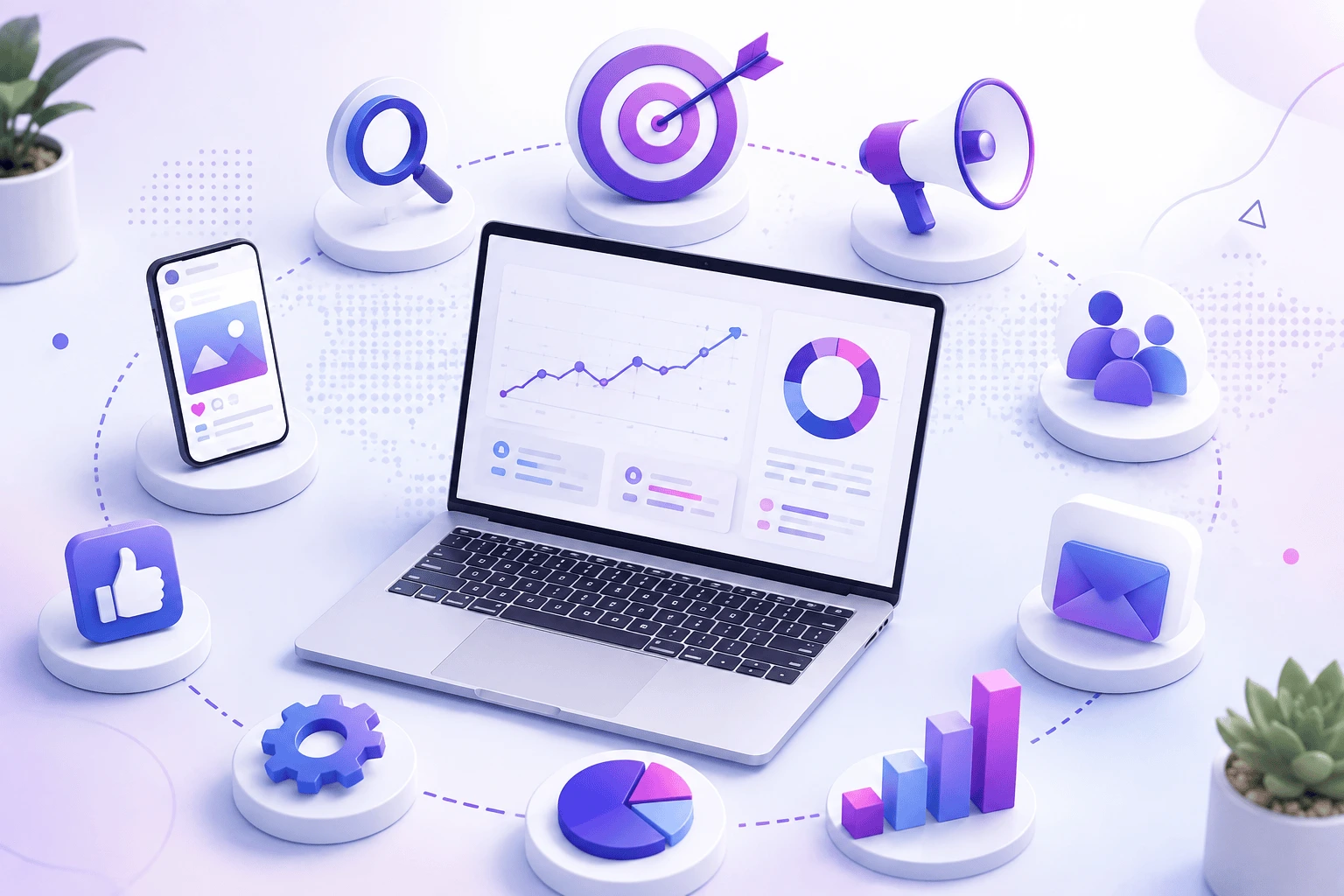
- The strategies of digital marketing fall into nine core categories: SEO, content marketing, social media, paid advertising, email marketing, AEO/AI search optimisation, influencer marketing, conversion rate optimisation, and data analytics.
- No single strategy works in isolation — the businesses that grow fastest in 2026 combine two or three complementary strategies rather than spreading budget thin across all of them.
- Search behaviour has changed: AI Overviews, AI Mode and chat-based assistants now answer queries directly, which means AEO (Answer Engine Optimisation) has become as important as traditional SEO.
- Budget, industry and buying cycle should determine which strategies you prioritise first — there is no universal “best” strategy.
Digital marketing strategies are the specific channels and methods businesses use to reach, engage and convert customers online — including SEO, content, social media, paid ads, email, and newer AI-search strategies like AEO. Rather than choosing one, effective digital marketers combine a small number of complementary strategies matched to their audience, budget and buying cycle. This guide breaks down each strategy, when to use it, what it costs, and how Australian SMEs are applying them in 2026, so you can build a plan instead of guessing.
What Is a Digital Marketing Strategy?
A digital marketing strategy is a defined plan for using online channels — search, content, social, email, paid ads and AI-driven search — to reach a specific audience and move them toward a business goal. Unlike a single tactic (like “post on Instagram”), a strategy sets the why, who and how, then chooses the channels that serve it. The Australian Government’s digital strategy guidance frames this as setting measurable digital goals first, then working backward into channel selection — a sequence many small businesses skip.
A useful way to think about it: tactics are individual actions; strategy is the system that connects them to revenue.
The 9 Core Strategies of Digital Marketing
The core strategies of digital marketing are SEO, content marketing, social media marketing, paid advertising, email marketing, AEO/AI search optimisation, influencer marketing, conversion rate optimisation, and data analytics. Each targets a different stage of the customer journey, from first discovery through to repeat purchase.
| Strategy | Best for | Typical cost | Time to results |
| SEO | Long-term organic visibility | Low–medium (time-intensive) | 3–6+ months |
| Content marketing | Trust, education, SEO/AEO fuel | Low–medium | 2–6 months |
| Social media marketing | Brand awareness, community | Low–medium | Weeks–months |
| Paid advertising (PPC/social ads) | Fast, measurable leads | Medium–high | Days–weeks |
| Email marketing | Retention, repeat sales | Low | Weeks |
| AEO / AI search optimisation | Visibility in AI Overviews, ChatGPT, Gemini | Low–medium | 2–6 months |
| Influencer/UGC marketing | Trust, reach in niche audiences | Low–high (varies) | Weeks–months |
| Conversion rate optimisation (CRO) | Turning existing traffic into leads | Low–medium | Weeks |
| Data & analytics | Measuring and improving every strategy above | Low (tools) | Ongoing |
Below, each strategy is broken down with what it is, when to use it, and a realistic view of the effort involved.
1. Search Engine Optimisation (SEO)
SEO is the strategy of improving a website so it ranks higher in organic (unpaid) search results for the terms your customers search. It covers technical site health, on-page content, and off-page authority (backlinks). SEO is the slowest strategy to show results but typically delivers the best long-term return because organic rankings keep generating traffic without ongoing ad spend.
When to use it: if your business relies on people actively searching for what you offer (e.g. “plumber near me,” “digital marketing courses Australia”), SEO should usually be your foundation strategy, not an afterthought.
Common mistake: treating SEO as a one-off project. Google’s own Search Essentials guidance is explicit that helpful, people-first content maintained over time outperforms content published once and abandoned.
2. Content Marketing
Content marketing is the strategy of creating and distributing genuinely useful content — blog posts, guides, videos, case studies — to attract and retain a defined audience. It underpins almost every other strategy: SEO needs content to rank, AEO needs content structured for AI answers, social media needs content to post, and email needs content to send.
Expert commentary: the businesses getting the most from content in 2026 aren’t publishing more — they’re publishing content that demonstrates real experience (E-E-A-T), because generic AI-written content is now easy for both readers and search engines to spot and discount.
Best practice: structure content around real customer questions, not keyword lists. Answering “how much does X cost” or “what’s the difference between X and Y” earns featured snippets and AI Overview citations more reliably than generic overviews.
3. Social Media Marketing
Social media marketing uses platforms like Instagram, TikTok, LinkedIn and Facebook to build brand awareness, community and, increasingly, direct sales through social commerce. It’s the most visible strategy but also the most time-intensive to run well, since algorithms reward consistent, platform-native content rather than repurposed ads.
When to use it: strong for brand awareness, community-building, and reaching younger or visually-driven audiences. Short-form video (Reels, TikTok, YouTube Shorts) is currently the highest-engagement content format across Australian audiences.
Pros and cons:
| Pros | Cons |
| Low cost to start | Organic reach is declining without ad spend |
| Builds direct community/trust | Algorithm changes require constant adaptation |
| Strong for visual/service businesses | Time-intensive to post consistently |
4. Paid Advertising (PPC & Social Ads)
Paid advertising — including Google Ads (search, display, shopping) and paid social (Meta, LinkedIn, TikTok Ads) — buys immediate visibility and traffic rather than earning it over time. It’s the fastest strategy to generate measurable leads, which makes it useful for testing offers, filling short-term pipeline gaps, or validating a new product before investing in SEO.
When to use it: when you need results within days or weeks, or when you want to test messaging before committing to organic content strategy. Paid ads stop producing results the moment spend stops, so they work best layered on top of organic strategies, not instead of them.
5. Email Marketing
Email marketing is the strategy of nurturing leads and retaining customers through direct, owned communication channels — newsletters, automated sequences, and promotional campaigns. Because it doesn’t rely on a search algorithm or social platform, it remains one of the highest-ROI strategies, and its importance is rising further as first-party data becomes more valuable amid tightening privacy rules.
Should you use it: yes, almost universally — even a simple monthly newsletter to existing customers tends to outperform cold outreach. Businesses collecting emails must follow Australia’s Spam Act rules around consent and unsubscribe options.
6. AEO & AI Search Optimisation (2026’s newest strategy)
Answer Engine Optimisation (AEO) is the strategy of structuring content so AI systems — Google AI Overviews, AI Mode, ChatGPT Search, Gemini, Perplexity — can extract and cite it directly as an answer. This differs from traditional SEO in one key way: instead of optimising purely to rank a blue link, AEO optimises for being quoted inside an AI-generated answer, often without a click.
Why it matters now: AI-powered search is no longer experimental — Google has rolled AI Overviews and AI Mode out broadly, and a large share of brands have already built generative AI into their marketing operations. Businesses that ignore AEO risk becoming invisible in a growing share of searches, even if their traditional rankings hold steady.
How to apply it: answer specific questions in the first 40–60 words of each section, use clear headings phrased as questions, back claims with credible sources, and keep information current — AI systems favour freshness and clarity over length.
7. Influencer & User-Generated Content (UGC) Marketing
Influencer marketing partners with creators who have an engaged audience to promote a product or service, while UGC marketing encourages real customers to create and share content organically. Both work by borrowing trust — audiences generally trust a creator or peer more than a brand’s own advertising.
When to use it: particularly effective for consumer brands, hospitality, beauty, and lifestyle services where visual proof and social trust drive purchase decisions.
8. Conversion Rate Optimisation (CRO)
CRO is the strategy of improving the percentage of website visitors who take a desired action — enquiring, buying, or signing up — without needing more traffic. It’s the most overlooked strategy on this list, yet often the cheapest to improve, because it works on traffic you’re already generating.
Common mistake: businesses pour budget into SEO and ads while their website has slow load times, unclear calls to action, or no social proof — all of which quietly cap the return on every other strategy.
9. Data & Analytics Strategy
A data and analytics strategy is the ongoing practice of measuring what each channel is actually producing — traffic, leads, cost per acquisition, and revenue — and using that data to reallocate budget. Without it, every strategy above is a guess. This is also where first-party data collection (email lists, CRM data) becomes a long-term asset as third-party tracking continues to be restricted.
How to Choose the Right Strategies for Your Business
The right digital marketing strategies depend on your budget, buying cycle and where your customers already spend attention — not on which strategy is trending. Use this checklist to prioritise:
- Define one measurable goal (e.g. 20 qualified leads/month) before picking channels.
- Identify where your audience already searches or scrolls — B2B audiences lean LinkedIn and search; consumer/lifestyle audiences lean social and short-form video.
- Match strategy to timeline: need leads this month → paid ads; building a 12-month asset → SEO and content.
- Start with two strategies, not six. Most small businesses fail by spreading a small budget across every channel instead of doing one or two well.
- Add AEO to your content strategy from day one rather than retrofitting it later — it costs little extra once content is already being produced.
- Review data monthly and shift budget toward what’s actually converting.
Common Mistakes to Avoid
- Choosing channels based on competitor presence rather than audience behaviour.
- Publishing content without a clear question it answers (hurts both SEO and AEO visibility).
- Running paid ads to a website with no clear conversion path.
- Ignoring email marketing because it feels “old” — it remains one of the highest-ROI channels.
- Treating AI search optimisation as optional rather than a 2026 baseline expectation.
Frequently Asked Questions
What are the main strategies of digital marketing? The main strategies are SEO, content marketing, social media marketing, paid advertising, email marketing, AEO/AI search optimisation, influencer marketing, conversion rate optimisation, and data analytics. Most businesses combine two or three based on budget and goals.
What is the difference between digital marketing and SEO? SEO is one strategy within digital marketing, focused specifically on organic search visibility. Digital marketing is the broader umbrella covering SEO, social, paid ads, email and more.
How much does digital marketing cost for a small business? Costs vary widely — email marketing can start near zero, while paid advertising typically needs an ongoing monthly budget. Many Australian SMEs start with a mix of SEO, content and a modest paid ads budget.
Which digital marketing strategy gives the fastest results? Paid advertising (Google Ads or social ads) typically produces the fastest measurable results, often within days, but stops generating traffic once spend stops.
What is AEO in digital marketing? AEO (Answer Engine Optimisation) is the strategy of structuring content so AI tools like Google AI Overviews, ChatGPT Search and Gemini can extract and cite it directly in AI-generated answers.
Can a small business do digital marketing without an agency? Yes. Many strategies — email marketing, basic SEO, organic social — can be run in-house, particularly with structured training such as Pulse Reach Digital’s courses.
What is the best digital marketing strategy for a local business? Local SEO combined with Google Business Profile optimisation and localised content typically performs best, since it targets people actively searching in a specific area.
How long does SEO take to show results? Most businesses see measurable movement in 3–6 months, with stronger compounding results after 6–12 months of consistent work.
Should I focus on organic or paid strategies first? If budget is limited, most experts recommend starting with organic strategies (SEO, content, email) for long-term value, layering in paid ads for short-term lead flow when budget allows.
What industries benefit most from social media marketing? Consumer-facing industries — hospitality, beauty, fashion, fitness and lifestyle services — tend to see the strongest results from social media marketing due to its visual, trust-driven nature.
Ready to Put These Strategies to Work?
Understanding the strategies of digital marketing is the first step — applying them consistently is what drives growth. If you’d rather build these skills in-house, explore Pulse Reach Digital’s Services, or get in touch if you’d prefer a team to run it for you.

0 Comments