
What Is Social Media Marketing?
Social media marketing is the use of platforms like Facebook, Instagram, LinkedIn and TikTok to build brand awareness, engage an audience and generate leads or sales, through a mix of organic content and paid advertising. It sits alongside SEO and search advertising as one of the three main digital acquisition channels, but it works differently: rather than capturing existing demand (as search does), social media marketing builds relationships and prompts discovery.
For a small or medium Australian business, that usually means three things working together: a content plan for organic posts, a paid campaign on at least one platform, and a process for turning comments, messages and clicks into actual enquiries. Done well, it supports the rest of a digital marketing plan rather than replacing it — most businesses still need search visibility for the moment someone is ready to buy, and social media for the moments before that, when they’re deciding who to trust.
Social media marketing in Australia looks different this year than it did twelve months ago. A new federal law now keeps under-16s off Facebook, Instagram and several other platforms. Meta’s ad costs have climbed again. And the businesses still winning attention aren’t the ones posting the most — they’re the ones posting the right content, on the right platform, backed by a small, consistent paid budget. This guide covers what social media marketing actually means in 2026, how Facebook marketing fits into the mix, what it costs, and the strategy steps that separate businesses getting real leads from those just filling a content calendar.
Why Social Media Marketing Matters for Australian Businesses in 2026
Social media reaches 21 million Australians — 77.7% of the population — and the average user is active on six different platforms, up from the more concentrated, single-platform habits of a decade ago. That spread matters for strategy: a single-platform approach now reaches a narrower slice of the market than it used to.
Behaviour has shifted too. Roughly a third of Australians now use social platforms specifically to research products and brands before buying, not just to keep up with friends. For service businesses, that means a Facebook page, an Instagram profile or a set of reviews doing the work a shopfront window used to do — someone forms an opinion about your business before they ever land on your website.
- 21.0 million Australians (77.7% of the population) actively use social media
- 87.0% of Australian adults use at least one social platform
- The average Australian uses around six different social platforms
- Roughly a third of users visit social platforms to research products and brands
Australia’s Under-16 Social Media Law: What It Means for Marketers
Since 10 December 2025, Australia’s Online Safety Amendment (Social Media Minimum Age) Act has required age-restricted platforms — including Facebook, Instagram, Threads, Snapchat and YouTube — to take reasonable steps to stop under-16s holding accounts. It’s the first law of its kind anywhere in the world, and it’s already changing who marketers can reach on these platforms.
The eSafety Commissioner’s regulatory guidance sets out what counts as “reasonable steps,” favouring a layered, “waterfall” approach to age verification rather than users simply self-declaring their age. Platforms that don’t comply can face fines of up to A$49.5 million. Meta began removing under-16 accounts from Facebook, Instagram and Threads in the weeks before the deadline, using facial scans or ID checks to verify age where needed.
For marketers, the practical effect is an older, more verified audience on the platforms this law covers. Messaging apps, online gaming, professional networking (including LinkedIn) and services aimed primarily at education sit outside the restriction, so B2B and professional-services campaigns are largely unaffected. Businesses targeting a younger consumer audience through Facebook or Instagram should expect that audience to skew older through 2026, and should review campaign targeting and creative accordingly. The OAIC’s privacy guidance on the scheme is worth reading if your business collects any age or identity data from customers via social channels, since the privacy obligations run alongside eSafety’s.
Example Monthly Social Media Content Calendar
Consistency is one of the biggest drivers of social media success. Instead of posting randomly, plan your content around different objectives such as education, engagement, social proof, and promotion. The sample calendar below provides a balanced monthly schedule that Australian businesses can adapt for Facebook, Instagram, LinkedIn, or TikTok.
| Week | Monday | Wednesday | Friday |
|---|---|---|---|
| Week 1 | Educational Tip or Industry Insight | Behind-the-Scenes Team Photo | Customer Testimonial or Case Study |
| Week 2 | Quick Video (Reel) | FAQ Carousel | Limited-Time Promotion |
| Week 3 | Blog Post or Helpful Guide | Poll or Interactive Question | Client Success Story |
| Week 4 | Industry News Update | Product or Service Showcase | Call-to-Action & Free Consultation |
Content Mix Recommendation
- 📘 40% Educational Content
- ⭐ 25% Customer Success & Reviews
- 🎥 20% Behind-the-Scenes & Brand Storytelling
- 💼 15% Promotional Offers & Lead Generation
This balanced approach keeps your audience engaged while building trust and generating consistent enquiries without overwhelming followers with sales-focused content.
Choosing the Right Platforms for Your Business
The right platform depends on your audience and offer more than any single “best” platform — Facebook and YouTube still deliver the broadest reach in Australia, Instagram and TikTok skew younger and more visual, and LinkedIn suits B2B. The table below summarises current reach and fit.
| Platform | Approx. ad reach in Australia | Best suited to |
|---|---|---|
| ~17.7 million (65%) | Local services, trades, real estate, community groups, lead generation | |
| YouTube | ~21.0 million (78%) | Long-form video, brand awareness, tutorials, product demonstrations |
| ~15.2 million | Visual brands, retail, hospitality, younger consumer audiences | |
| TikTok | Fastest-growing among under-30s | Discovery-driven, entertainment-led brands, younger audiences |
| Smaller, professional audience | B2B, professional services, recruitment |
Figures are advertising-audience estimates from Meta and Google’s own ad planning tools, cited via DataReportal’s Digital 2026 Australia report; treat them as planning benchmarks rather than exact user counts.
Most Australian SMEs get more value from doing one or two platforms properly than spreading thin across five. If you’re weighing social against search spend, it’s worth reading how we’ve approached our SEO work in Blacktown — the two channels compound each other when they’re pointed at the same audience.
| Platform | Best For | Primary Audience | Content That Performs Best | Advertising Potential | Lead Generation | Difficulty |
|---|---|---|---|---|---|---|
| Local businesses, trades, healthcare, real estate, service providers | 30–65+ | Reels, Local Offers, Community Posts, Testimonials | ★★★★★ | Excellent | Easy–Medium | |
| Retail, Beauty, Hospitality, Restaurants, Lifestyle Brands | 18–40 | Reels, Stories, Carousel Posts | ★★★★★ | Very Good | Medium | |
| B2B, Professional Services, Recruitment, SaaS | 25–60 Professionals | Industry Insights, Articles, Company Updates | ★★★★☆ | Excellent | Medium | |
| TikTok | E-commerce, Entertainment, Consumer Brands | 16–35 | Short Videos, Trends, Educational Clips | ★★★★☆ | Moderate | Medium–High |
| YouTube | Education, Tutorials, Product Reviews, Brand Building | All Ages | Long-form Videos, Shorts, Tutorials | ★★★★★ | Very Good | High |
Facebook Marketing in Australia: What Still Works in 2026
Facebook marketing in Australia still works, but organic reach alone rarely delivers results — success in 2026 depends on pairing consistent organic content with a modest, well-targeted paid budget and genuinely strong creative. Facebook’s algorithm now weighs video and Reels-style content more heavily than static posts, and every new ad set goes through a “learning phase” before delivery stabilises.
Organic Facebook Marketing
Organic posts still build trust and community, particularly through Facebook Groups and Marketplace, which remain heavily used in Australia. But organic reach for business Pages is a fraction of a Page’s follower count — plan on organic content warming an audience, not carrying the whole campaign.
Paid Facebook Marketing
Paid campaigns are where most measurable results come from. Meta’s own documentation notes that an ad set typically needs around 50 optimisation events within a rolling seven-day window before delivery stabilises — large mid-campaign changes (a budget shift of more than 20%, a full audience swap, or replacing all creative at once) can reset that learning and temporarily hurt performance. Reels placements also tend to cost meaningfully less per thousand impressions than Instagram Feed, while reaching a comparable audience, which makes them a cost-efficient option for awareness campaigns.
| Factors | Organic Facebook marketing | Paid Facebook marketing |
|---|---|---|
| Cost | Free (time cost only) | Ongoing ad spend |
| Reach | Small share of followers | Scales with budget and targeting |
| Best for | Community, reviews, customer service | Lead generation, sales, awareness at scale |
| Speed to results | Slow, compounding | Fast, but needs ongoing optimisation |
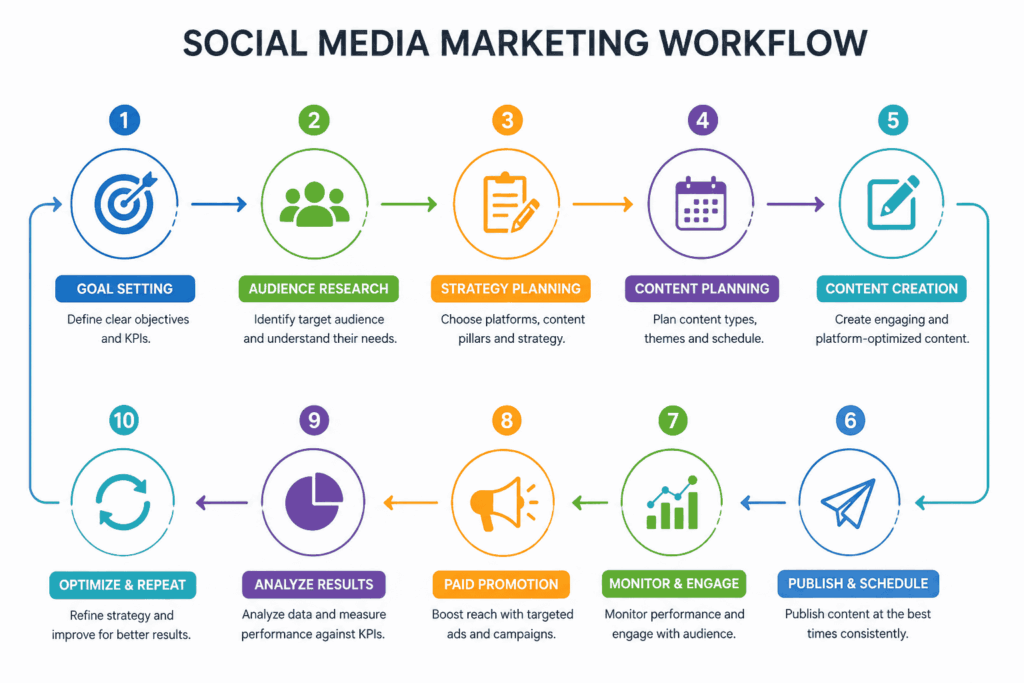
Building a Social Media Marketing Strategy: 7 Steps
A workable social media marketing strategy for an Australian SME has seven parts: clear goals, a defined audience, the right one or two platforms, a content plan, a paid budget, a measurement process, and a regular review cycle.
- Set one primary goal — leads, sales, awareness or reputation — rather than trying to optimise for all four at once.
- Define your audience by more than age and location; buying stage and pain points matter more to creative than demographics alone.
- Pick one or two platforms based on where that audience actually spends time, using the reach table above as a starting point.
- Plan content in batches — a monthly content calendar mixing educational, social-proof and promotional posts avoids last-minute scrambling.
- Commit a modest, ongoing paid budget rather than one-off boosted posts; consistency beats occasional spikes.
- Track a small number of KPIs — cost per lead, engagement rate and click-through rate tell you more than follower count.
- Review monthly and adjust — creative fatigue sets in faster than most businesses expect, particularly on Facebook and Instagram.
Local targeting adds a further layer for suburb- or region-based businesses. It’s a similar approach to how we’ve approached local search and paid social for Marsden Park businesses, where a fast-growing, car-dependent market needed geo-fenced targeting rather than a generic national campaign.
Content Types That Perform Best Right Now
Short-form video consistently outperforms static images across Facebook and Instagram in 2026, but the content that converts still needs a clear point, not just movement on screen.
- Short-form video (Reels/Stories) — favoured by the algorithm and typically cheaper to reach people with than feed placements.
- User-generated content and reviews — builds trust faster than brand-produced content, particularly for local and trade businesses.
- Behind-the-scenes content — humanises a business and performs well organically without needing production budget.
- Educational carousels or explainer posts — support AEO-style discovery when users search social platforms directly for information.
Common Mistakes Australian Businesses Make
- Posting across too many platforms at once instead of doing one or two properly
- Boosting posts occasionally instead of running a structured, ongoing paid campaign
- Changing targeting or creative mid-campaign and resetting the ad set’s learning phase
- Measuring success by likes and follower count instead of leads or sales
- Ignoring comments and messages, which damages trust faster on social platforms than almost anywhere else online
How Much Does Social Media Marketing Cost in Australia?
Cost varies widely by industry and goal, but Australian Facebook and Instagram advertisers are generally seeing higher cost-per-click and cost-per-thousand-impression rates in 2026 than in the previous two years, driven by more advertisers competing for the same inventory. There’s no single “normal” figure — a local trades business bidding on a low-competition audience will pay far less per click than a finance or legal brand competing in a high-value category.
Rather than anchoring to a specific dollar figure, it’s more useful to budget by outcome: decide what a lead or sale is worth to your business, then set a monthly spend that lets a campaign gather enough data to optimise (Meta’s own guidance points to roughly 50 conversion events in a week as the threshold for a campaign to exit its learning phase). Agency or freelance management fees sit on top of ad spend and vary by scope — ongoing content production, paid campaign management and reporting cost more than organic posting alone.
Typical Social Media Marketing Investment in Australia
Every business has different goals, competition levels, and advertising needs. The figures below are general investment ranges to help you understand what different levels of social media marketing typically include.
- ✓ Organic content management
- ✓ 8–12 monthly posts
- ✓ Basic audience engagement
- ✓ Monthly reporting
- ✓ Best for small local businesses
$3,000/month
- ✓ Organic + Paid Social
- ✓ Facebook & Instagram Ads
- ✓ Lead Generation Campaigns
- ✓ Audience Targeting
- ✓ Monthly Strategy Reviews
- ✓ Multi-platform campaigns
- ✓ Advanced Meta Ads
- ✓ Creative production
- ✓ Conversion optimisation
- ✓ Dedicated account manager
Should You DIY Social Media Marketing or Hire an Agency?
DIY social media marketing can work for a business with the time to post consistently and learn ad platforms properly, but most Australian SMEs get better results, faster, from a specialist managing paid campaigns while an in-house team handles day-to-day community engagement. The trade-off is time versus expertise: ad platforms change often enough that staying current is close to a part-time job in itself.
If you’re weighing that decision, it’s worth looking at it as part of a full-service digital marketing strategy rather than social media in isolation — search, paid social and content usually perform better together than any one channel run alone.
Frequently Asked Questions
What is social media marketing?
Social media marketing is the use of platforms such as Facebook, Instagram, LinkedIn and TikTok to build brand awareness, engage an audience, and generate leads or sales through a combination of organic posting and paid advertising.
What is Facebook marketing?
Facebook marketing is the use of Facebook Pages, Groups, Marketplace and paid advertising to reach and engage an audience on the platform, typically combining organic content with a targeted paid campaign for measurable results.
How does social media marketing differ from SEO?
SEO captures existing demand from people actively searching, while social media marketing builds awareness and relationships that create demand over time. Most businesses benefit from running both together.
Why does social media marketing matter for Australian businesses?
Social media reaches 77.7% of the Australian population, and around a third of users research products and brands directly on these platforms before buying, making a presence there part of how customers evaluate trust.
How has Australia’s under-16 social media law affected marketing?
Since 10 December 2025, age-restricted platforms including Facebook and Instagram must take reasonable steps to remove under-16 users, which is shifting the reachable audience on those platforms toward an older, more verified user base.
What is the best social media platform for a small business in Australia?
There’s no single best platform — Facebook and YouTube offer the broadest reach, Instagram and TikTok suit visual and younger-skewing brands, and LinkedIn suits B2B and professional services. The right choice depends on where your specific audience spends time.
Can a business succeed on Facebook using only organic posts?
It’s difficult. Organic reach for business Pages is a small share of total followers, so most businesses need at least a modest paid budget alongside organic content to see measurable results.
How much should a small business budget for social media marketing?
Budgets vary by industry and competition. Rather than a fixed figure, it’s more useful to set spend based on what a lead or sale is worth to the business and ensure the campaign gathers enough data to optimise.
What is a good social media engagement rate?
Engagement rate benchmarks vary significantly by platform, industry and audience size, so they’re best used to track a business’s own trend over time rather than compared against a single universal target.
Should a business use an agency for Facebook ads or manage them in-house?
It depends on available time and expertise. In-house management can work well for day-to-day community engagement, while paid campaign management often benefits from specialist experience given how frequently ad platforms change.
What is the difference between organic and paid social media marketing?
Organic social media marketing relies on unpaid posts reaching followers and their networks, while paid social media marketing uses advertising budget to reach a targeted audience beyond existing followers, typically with faster and more measurable results.
Do social media algorithms favour video content?
Short-form video formats such as Reels are currently favoured by Facebook and Instagram’s algorithms and often cost less to reach audiences with than static image posts in the same placement.
When should a business change its social media strategy?
A monthly review is a reasonable minimum, since creative fatigue and audience shifts can affect performance faster than expected, particularly on fast-moving platforms like Facebook and Instagram.
Who regulates social media platforms in Australia?
The eSafety Commissioner regulates online safety obligations including the social media minimum age scheme, while the Office of the Australian Information Commissioner (OAIC) oversees the related privacy provisions.
Getting Started
Social media marketing in Australia rewards businesses that pick their platforms deliberately, back organic content with a steady paid budget, and stay across regulatory changes like the under-16 law rather than treating social as a set-and-forget channel. If you’d like a second opinion on where your current strategy stands, you’re welcome to book a free consultation with Pulse Reach Digital.



0 Comments