

Type a question into Google today and something has changed. Instead of ten blue links, you often see an AI-generated answer sitting above everything else — built from the sources Google decided understood your question best. That shift didn’t happen because Google got better at counting keywords. It happened because Google got better at understanding meaning. This is semantic search: the move from matching words to matching intent.
For Australian SMEs, and the agencies helping them compete online, this isn’t a technical footnote. It’s the difference between being cited in an AI Overview and disappearing from the page entirely. This guide unpacks what semantic search actually is, why keyword stuffing stopped working, and exactly how to structure content so it satisfies both human readers and the AI systems now standing between your business and its next customer.
What Is Semantic Search?
Semantic search is how search engines interpret the meaning and intent behind a query rather than just matching its exact words. It uses natural language processing, entity recognition and knowledge graphs to connect concepts, so a search for “affordable web design Sydney” can return relevant results even if that exact phrase never appears on the page.
This isn’t a brand-new concept. Google’s RankBrain (2015) and BERT (2019) were early steps toward understanding language contextually rather than literally. What’s changed is scale and visibility: those same semantic principles now power the large language models generating AI Overviews, AI Mode and conversational answers across Google, Bing, ChatGPT, Gemini, Claude and Perplexity.
Google Cloud describes semantic search as a technique that aims to comprehend the deeper meaning and intent behind a search, considering the relationships between words, the searcher’s context and prior behaviour, rather than only matching literal terms.
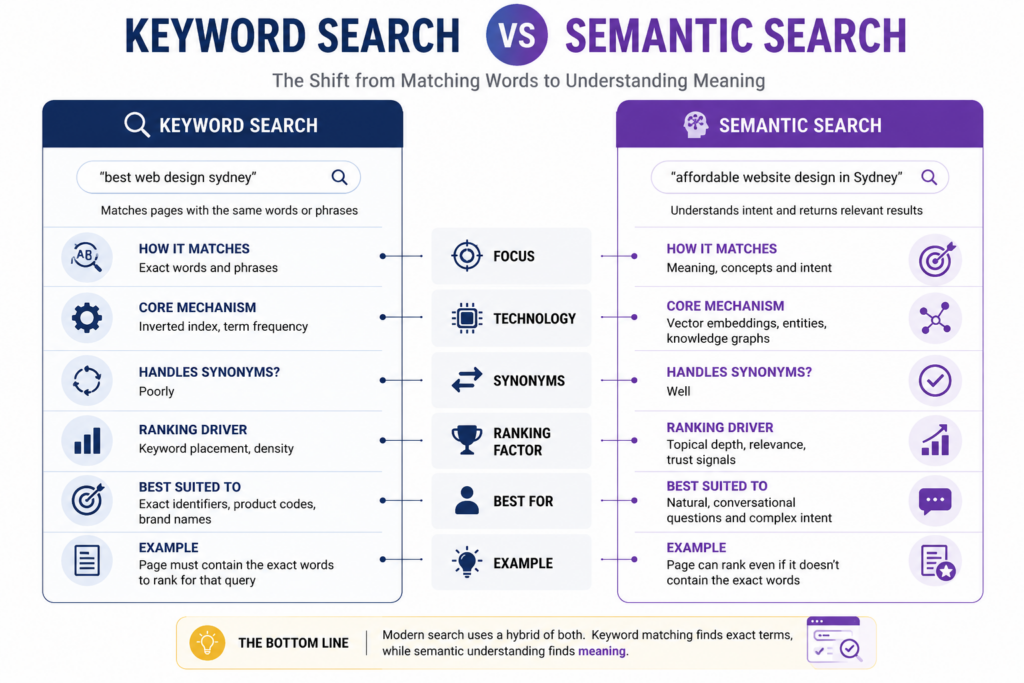
Keyword Search vs Semantic Search: What’s Actually Changed
Keyword search relies on an inverted index — essentially a lookup table matching words to the pages that contain them, ranked by frequency and placement. It’s fast and effective when the searcher and the content use the same exact terms, but it struggles the moment synonyms, ambiguity or conversational phrasing enter the picture.
Semantic search instead converts both the query and the content into vector representations that capture meaning, so it can recognise that “redo a bathroom” and “bathroom renovation” describe the same underlying need. The table below summarises the practical differences.
| Factor | Keyword Search | Semantic Search |
| How it matches | Exact words and phrases | Meaning, concepts and intent |
| Core mechanism | Inverted index, term frequency | Vector embeddings, entities, knowledge graphs |
| Handles synonyms? | Poorly | Well |
| Ranking driver | Keyword placement, density | Topical depth, relevance, trust |
| Best suited to | Exact identifiers, product codes | Natural, conversational questions |
In practice, most modern search systems run a hybrid of both: keyword matching to catch exact identifiers (product codes, brand names, specific model numbers) and semantic matching to catch everything conversational, ambiguous or intent-driven — which today makes up the majority of everyday search queries.
How Google Understands Meaning, Not Just Words
Entity Recognition
An entity isn’t just a word — it’s a concept with attributes and relationships. “Sydney” is an entity (a city). “NDIS” is an entity (a government scheme). “Digital marketing” is an entity (an industry discipline). When your content clearly identifies entities and explains how they relate to each other, you help search engines place your page correctly within a much larger web of concepts — not just match a string of text.
Knowledge Graphs
Google’s Knowledge Graph maps billions of entities and the relationships between them. Content that mentions relevant entities and explains their real-world connections — rather than just repeating a target keyword — aligns more naturally with how this graph organises information, which increases the likelihood of being surfaced for related queries beyond the exact keyword you targeted.
Vector Embeddings and NLP
Under the hood, transformer-based language models convert text into embeddings — mathematical representations of meaning — then compare how close a query and a piece of content sit within that meaning space. This is why a well-written, topically comprehensive article can rank for dozens of related phrases it never explicitly contains.
Why Search Intent Now Outweighs Keyword Density
Every query carries an underlying intent, and matching that intent now matters more than matching the words themselves:
- Informational — the searcher wants to learn something (“what is semantic search”)
- Navigational — the searcher wants a specific site or brand (“Pulse Reach Digital login”)
- Commercial investigation — the searcher is comparing options before buying (“best SEO agency Australia”)
- Transactional — the searcher is ready to act (“hire SEO consultant Sydney”)
Content built for the wrong intent underperforms no matter how well it’s keyword-optimised. A commercial investigation query answered with a hard sales page, or an informational query answered with thin, promotional content, tends to satisfy neither the reader nor the ranking systems evaluating helpfulness.
The Rise of AI Overviews: Why This Matters More Than Ever
AI Overview prevalence varies by measurement methodology, but the direction is consistent: BrightEdge’s commercial-vertical tracking put coverage at roughly 48% of tracked queries by March 2026, while Google’s own disclosures have cited a figure of around 50% of US queries. Independent trackers using different keyword sets and methodologies report figures anywhere from 20% to over 60%, but all confirm the same trend — AI-generated answers are now a standard, not experimental, part of the results page.
Informational queries remain the biggest trigger, with research putting the share of AI Overview-triggering queries with informational intent at roughly 88–91%. That share is gradually declining as Google extends AI Overviews into commercial and navigational queries too — the exact categories that matter most for SME marketing.
Perhaps the most important shift for content strategy: analysis from Ahrefs and ALM Corp found that only around 38% of pages cited in AI Overviews also rank in the organic top 10 — down sharply from about 76% roughly seven months earlier. Ranking #1 no longer guarantees a citation. Being structured clearly enough for an AI system to extract a confident answer increasingly matters just as much as traditional ranking position.
There’s also a real reward for being cited. Seer Interactive’s 2026 research found that brands cited within AI Overviews earn substantially more organic clicks per impression than uncited competitors on the same queries — meaning visibility inside the AI answer, not just below it, is now a measurable commercial advantage. Notably, Google’s own guidance on AI-generated content confirms that using automation to produce content isn’t penalised in itself — it becomes a problem only when the primary purpose is to manipulate rankings rather than to help people.
How to Optimise Content for Semantic Search and Intent
Build Topical Authority With Content Clusters
Rather than writing isolated posts chasing individual keywords, structure content around a core topic with supporting pieces that cover every angle a reader (and an AI system) would expect: a pillar page on “digital marketing services” supported by clusters on SEO, content strategy, paid media and local search, each interlinked. This topical depth signals genuine expertise rather than a single lucky keyword match.
Write for Entities and Relationships, Not Just Keywords
Mentioning your service repeatedly matters less than explaining how it connects to the concepts your customers actually care about — cost, timeframe, compliance, comparison with alternatives, and outcomes. A sentence like “digital marketing services help SMEs compete against larger, better-funded competitors through targeted local SEO and content strategy” does far more semantic work than the keyword alone repeated five times.
Use Natural, Conversational Language
Write as though you’re answering a knowledgeable colleague’s question, not targeting an algorithm. Semantic systems are tuned to recognise — and increasingly penalise — unnatural, keyword-stuffed phrasing, while rewarding clear, conversational writing that a human would actually want to read.
Structure Content for Answer Extraction (AEO)
Open important sections with a concise, direct answer of roughly 40–60 words before expanding into detail. Use natural question-style subheadings (“what,” “how,” “why,” “cost,” “best”), and build out a dedicated FAQ section — research shows the majority of AI Overviews now also include a related People Also Ask section, so answering adjacent questions directly increases the surface area for extraction.
Add Schema Markup
Schema, using the structured vocabulary maintained by schema.org, gives search engines explicit signals about what your content is — an Article, an FAQPage, a LocalBusiness, a Product — reducing the ambiguity that would otherwise rely purely on inference. It doesn’t guarantee ranking, but it materially improves how confidently a system can extract and cite your content.
Demonstrate E-E-A-T
Google’s own guidance on creating helpful, people-first content states plainly that content should be created primarily to help people, not to manipulate rankings, and that of the four E-E-A-T qualities — Experience, Expertise, Authoritativeness and Trustworthiness — trust is the most important. Real examples, transparent sourcing, clear authorship and balanced, accurate advice all feed directly into this.
Common Mistakes Australian Businesses Make with Semantic SEO
- Still keyword-stuffing headings and paragraphs instead of writing naturally
- Publishing thin, surface-level content that only partially answers the query
- Skipping FAQ sections and schema markup that make content easier to extract
- Chasing search volume instead of matching genuine search intent
- Treating content as search-engine-first rather than people-first — the exact pattern Google’s Search Essentials and Helpful Content guidance are designed to identify and rank down
- Ignoring topical depth in favour of scattered, one-off blog posts with no cluster structure
A Quick Semantic Search Checklist for SMEs
- Map content to real search intent, not just keyword volume
- Build topic clusters instead of isolated, disconnected posts
- Open key sections with a direct, concise answer
- Use natural language and answer real customer questions
- Add relevant schema markup (Article, FAQPage, LocalBusiness)
- Demonstrate genuine experience and expertise, not just claims
- Link related content internally to reinforce topical relationships
- Review and refresh content regularly rather than publishing and forgetting it
The Bottom Line
Keywords haven’t disappeared — they still help confirm relevance and reflect how people phrase their questions. But they’re no longer the main lever. Semantic search rewards businesses that write clearly, cover a topic properly, and genuinely help the person on the other end of the query. For Australian SMEs navigating a search landscape increasingly mediated by AI Overviews and answer engines, that shift is an opportunity: topical depth and real expertise are far harder for larger, less specialised competitors to fake.
If you’re not sure whether your current content is built for keywords or built for intent, Pulse Reach Digital can review your existing pages and show you exactly where the gaps are — no obligation, just a clear picture of where you stand.
FAQ Section
What is semantic search in simple terms?
Semantic search is how modern search engines work out what you mean, not just what you typed. Instead of matching exact words, it uses AI and natural language processing to understand the concepts, entities and intent behind a query, then matches that meaning to the most relevant content.
How is semantic search different from keyword search?
Keyword search matches the literal words in a query to the literal words on a page. Semantic search matches meaning: it can connect a search for “cost to redo a bathroom” with a page about “bathroom renovation pricing” even though the wording differs.
Do keywords still matter for SEO?
Yes, but as one signal among many rather than the main lever. Keywords still help confirm topical relevance and match how people phrase queries, but content also needs topical depth, entity relationships and genuine helpfulness to rank well.
What is search intent and why does it matter?
Search intent is the underlying goal behind a query: informational, navigational, commercial investigation or transactional. Content that matches the wrong intent (for example, a sales page for an informational query) tends to underperform regardless of keyword optimisation.
How do AI Overviews use semantic search?
AI Overviews generate a summarised answer by identifying content that best matches the meaning of a query, then pulling from sources that demonstrate clear, well-structured, trustworthy answers. Ranking highly in traditional search no longer guarantees inclusion in the overview.
Does ranking #1 on Google guarantee an AI Overview citation?
No. Independent analysis has found that a shrinking share of AI Overview citations also appear in the organic top 10, meaning Google is increasingly pulling from a broader set of well-structured pages rather than only the top-ranked ones.
What are entities in SEO?
An entity is a distinct concept, such as a place, organisation, product or idea, that search engines recognise and connect to related concepts through a knowledge graph. Writing content that clearly identifies and relates entities helps search engines understand context beyond individual keywords.
How do I optimise a blog post for AEO (answer engine optimisation)?
Open key sections with a concise, direct answer (roughly 40–60 words) before expanding into detail. Use natural question-style subheadings, add FAQ sections, and mark up content with appropriate schema so AI systems can extract clear, quotable answers.
Is schema markup necessary for semantic SEO?
It’s not mandatory for ranking, but it materially helps. Schema gives search engines explicit, structured signals about what your content is (an article, FAQ, product, local business) and reduces ambiguity that would otherwise rely on inference.
What is E-E-A-T and how does it relate to semantic search?
E-E-A-T stands for Experience, Expertise, Authoritativeness and Trustworthiness. Google has stated trust is the most important of these. Semantic systems weigh E-E-A-T signals alongside topical relevance when deciding which sources are reliable enough to cite or rank.
How long should content be to rank for semantic search?
There’s no fixed word count. The right length is whatever fully and accurately answers the query and related questions a reader would naturally have next, without padding. Thin content that only covers the surface of a topic typically underperforms comprehensive, well-organised content.
Can small Australian businesses compete with big brands on semantic search?
Yes. Because semantic search rewards topical depth, clarity and genuine expertise rather than raw domain authority alone, a well-structured content strategy focused on a specific niche or local market can outperform generic, broad content from larger competitors.




0 Comments